


Messaging mismatch rarely looks like a mistake.
The ad is clean. The promise is reasonable. The landing page looks polished. Nothing jumps out as deceptive.
And yet — the ads get rejected, or worse, they run but never really stabilize.
I’ve had funnels where everything looked aligned at a glance. Same offer, same audience, same intent.
But when you actually stepped through the experience, something shifted.
Not enough to call it “wrong”. Just enough to make the flow feel inconsistent.
That’s usually where things break.
Because platforms don’t evaluate ads and landing pages separately.
They evaluate the transition between them.
And that’s where messaging mismatch becomes visible.
Why Messaging Mismatch Triggers Ad Rejections
Most people assume rejections come from obvious violations — misleading claims, restricted content, exaggerated promises.
In practice, a lot of rejections happen without any of that.
The issue isn’t what you say.
It’s how consistently you say it across the funnel.
I’ve seen ads that were completely compliant on their own get rejected simply because the landing page shifted tone, emphasis, or framing.
Nothing false. Just different.
And that difference creates ambiguity.
From the system’s perspective, ambiguity increases risk.
So the safest assumption becomes: reject or limit.
It’s Not About Words — It’s About Interpretation
You can technically say the same thing in both the ad and the landing page — and still trigger a mismatch.
Because platforms don’t compare text literally.
They reconstruct meaning.
I’ve had cases where the ad said “earn up to $900”, and the landing page said “$150–$900 depending on conditions”.
Same idea.
Different interpretation.
That gap is enough.
Once the system sees two slightly different versions of the same promise, it has to resolve which one is “true”.
And when it has to guess, risk goes up.
Where Messaging Mismatch Actually Happens
Most mismatches are not obvious contradictions.
They show up in small structural shifts:
ad is exploratory → page is aggressive
ad is neutral → page implies outcomes
ad simplifies → page introduces conditions
This is usually how it looks in practice:
Ad: “Discover how this method works” (neutral, exploratory)
Landing page: “Get your 500% ROI system now” (aggressive, outcome-focused)
Result: intent mismatch → higher perceived risk
Each step feels justified.
Together, they break continuity.
I’ve had funnels where aligning just one sentence — not rewriting, just matching phrasing — improved approval stability.
That’s when it becomes clear how sensitive these systems are to alignment.
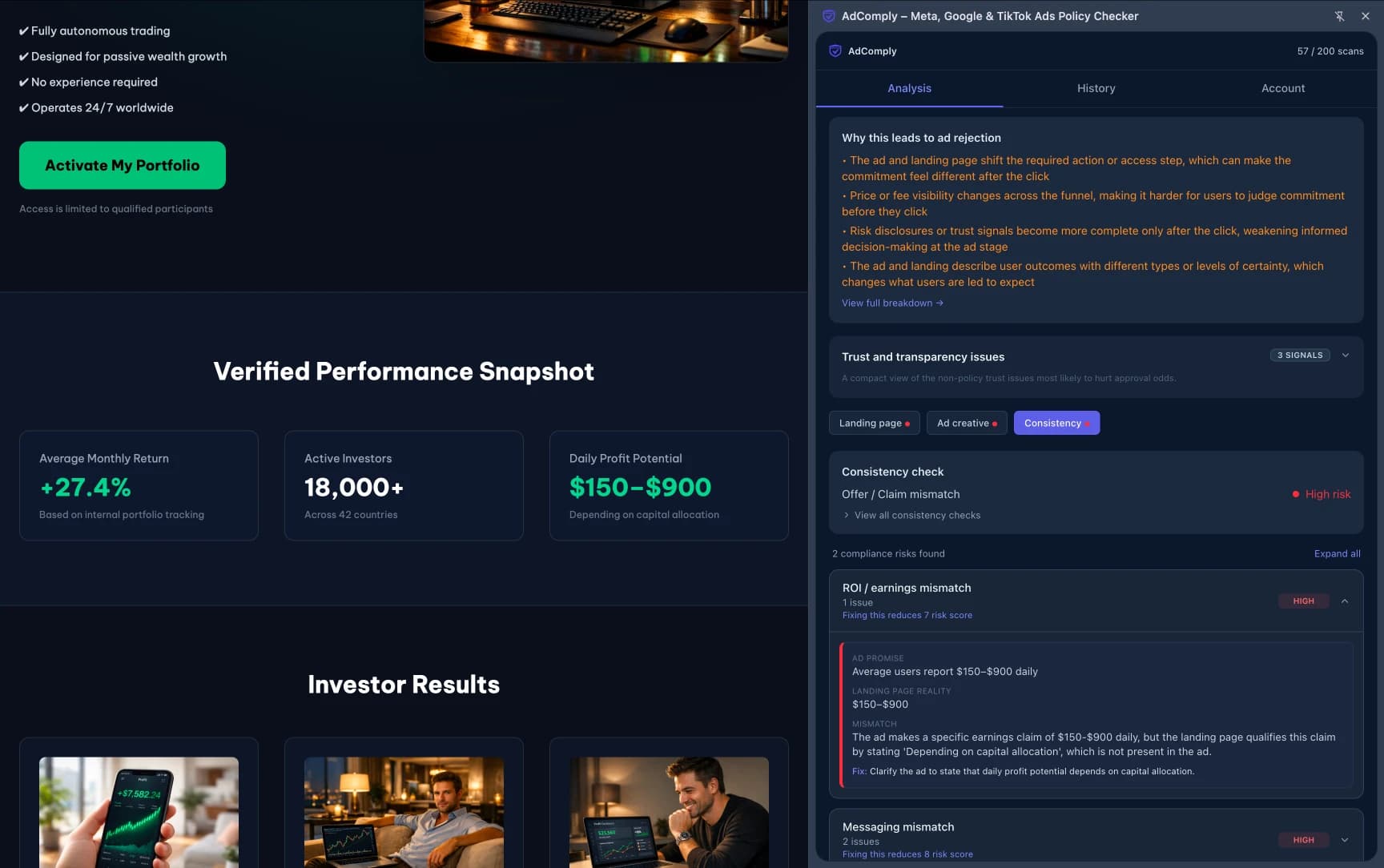
This kind of mismatch is subtle when you look at each piece separately. But when you follow the flow from ad to landing page, the shift becomes obvious.
This pattern shows up across many funnels — especially in cases where ads follow policy but still get rejected, because the issue isn’t the rule, it’s the alignment.
Timing Mismatch Is Just as Important as Message
One of the most overlooked causes of rejection is not what is said, but when it’s said.
I’ve seen funnels where the ad clearly explains the offer, but the landing page delays key details behind interaction.
From a content perspective, everything matches.
From a structural perspective, it doesn’t.
The user is asked to act before fully understanding.
That shift changes how intent is interpreted.
And intent is what the system evaluates.
Visual Messaging Can Break Consistency Too
It’s not just about copy.
Visuals carry meaning.
I’ve had cases where the ad used clean, neutral imagery, but the landing page introduced visual “results” — dashboards, growth charts, transformation-style visuals.
No direct claims.
But a different story.
That’s enough to shift classification.
Because platforms don’t separate text and visuals.
They evaluate the combined signal.
Mismatch Compounds Across the Funnel
This is where things become less obvious.
Find Rejection Risks Before You Submit
Scan your ad funnel for policy risks, risky claims, landing-page issues, and ad-to-page mismatches before review.
No signup required • instant results • 5 free scans included
A single mismatch might not cause rejection.
But multiple small inconsistencies stack.
I’ve seen funnels where:
the ad slightly overpromises
the landing page slightly reframes
the next step adds conditions
Each step is defensible.
Together, they form a pattern.
And once that pattern becomes recognizable, the outcome is predictable.
Why Messaging Mismatch Affects More Than Approval
Even when ads are not rejected, mismatch still has consequences.
I’ve seen campaigns where fixing alignment improved conversion rates without changing traffic.
Same audience. Same offer.
Different consistency.
Because when expectations match experience, users behave differently.
And platforms detect that.
How to Actually Diagnose Messaging Mismatch
Most people review ads and landing pages separately.
That’s the mistake.
You need to experience them as a sequence.
Start with the ad.
Click through.
Pay attention to what changes.
I’ve done this many times, and the issue almost always appears in the transition.
Not in a single element.
In the shift between them.
If you want to break this down further, see specific landing page elements that trigger ad rejections, where these mismatches often originate.
The Shift That Makes This Predictable
At some point, the question changes.
Not “is this compliant?”
But “does this create a consistent pattern?”
Before you launch: A quick scan can show the issues that often lead to ad rejection before you send the campaign for review.
Scan your funnel now →That shift is what makes messaging mismatch something you can actually control.
You stop comparing lines.
You start evaluating flow.
Because ads and landing pages are not separate assets.
They are one system.
And once that system loses alignment, rejection is no longer surprising.