


Why Facebook Ad Accounts Get Banned (And How to Avoid It)
If you run Facebook ads long enough, sooner or later you’ll encounter it.
You open Ads Manager expecting to check performance, and instead there’s a notification saying your advertising access has been restricted or the ad account has been disabled.
For many advertisers the first reaction is confusion.
The ads didn’t look spammy. The product is legitimate. Nothing seemed obviously against the rules.
But most ad account bans aren’t caused by one obvious mistake.
What usually triggers enforcement is the overall pattern your ads, landing pages, and account behavior create together.
Facebook rarely disables accounts because of a single ad. The system reacts to signals across the entire funnel.
Claims in ads that sound too strong
The most common trigger still comes from the wording used in the ad itself.
Facebook’s moderation systems are trained to detect language that often appears in misleading ads.
This includes phrases that promise extreme or guaranteed outcomes.
“lose weight fast”
“guaranteed results”
“make money automatically”
dramatic before-and-after transformations
In practice there are hundreds of variations of these patterns. Our AI algorithm AdComply currently detects more than 500 high-risk phrasing patterns that frequently trigger Facebook policy enforcement.
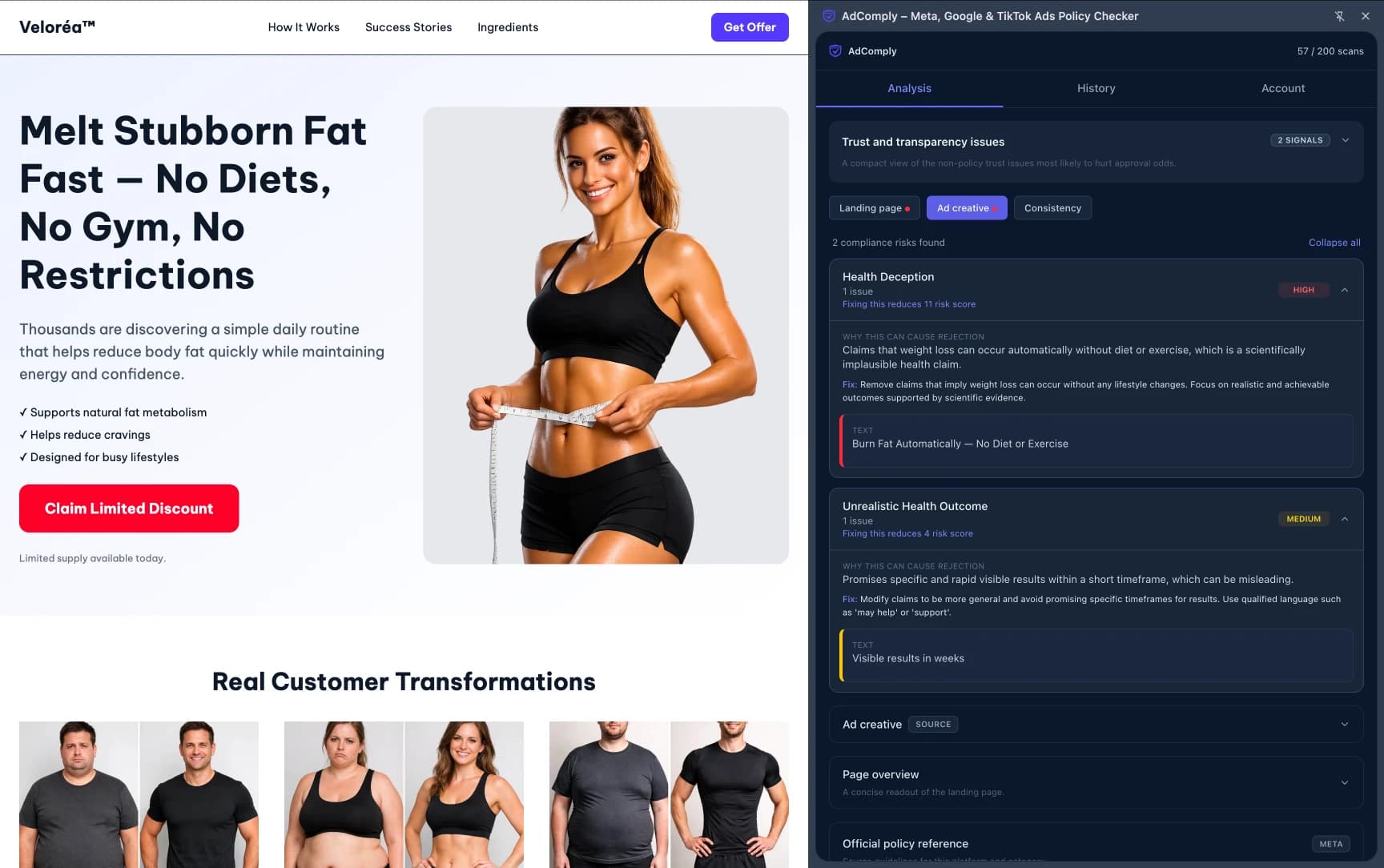
The tricky part is that sometimes the product itself is perfectly legitimate.
What causes problems is the way the benefit is framed. When the wording resembles patterns from previously flagged ads, the system treats it cautiously.
Landing pages are reviewed too
A mistake many advertisers make is assuming Facebook evaluates only the ad creative.
In practice the destination page is part of the review process as well.
And quite often that’s where the real issues appear.
For example, the ad might sound relatively neutral while the landing page contains stronger promises.
Sometimes the page includes aggressive testimonials, unrealistic results, or urgency elements that look misleading.
From Facebook’s perspective the ad and the page are one experience. If the page contains risky claims, the entire funnel can be flagged.

When the ad and the page tell different stories
A different issue appears when the ad and the landing page feel like two separate conversations.
The ad might look educational or informational, but after clicking the user ends up on a page that immediately pushes a strong sales pitch.
Advertisers often see this as normal marketing.
However, to the platform it can look like the ad is hiding the real intent of the page.
When that gap between the ad message and the landing page becomes too large, the funnel can start looking misleading.

Account behavior also influences enforcement
Not every restriction comes from ad copy.
The way an account behaves over time also matters.
A brand new ad account that suddenly starts spending large budgets can attract additional scrutiny. The same thing happens when several ads are rejected in a short period.
Find Rejection Risks Before You Submit
Scan your ad funnel for policy risks, risky claims, landing-page issues, and ad-to-page mismatches before review.
No signup required • instant results • 5 free scans included
Another pattern that tends to raise risk signals is constant editing — changing ads right after submission or switching domains frequently between campaigns.
Individually these actions aren’t violations.
But when several of them happen close together, the account can start looking unstable from the platform’s perspective.
Policy history accumulates over time
Facebook tracks policy history across multiple layers.
individual ads
the ad account
the business manager
the domain used in ads
If rejected ads keep appearing, enforcement usually escalates gradually.
It often starts with simple ad disapprovals. After that you may see temporary advertising restrictions.
When the system continues detecting risk signals, the ad account itself may eventually be disabled.
Before you launch: A quick scan can show the issues that often lead to ad rejection before you send the campaign for review.
Scan your funnel now →Why bans sometimes feel unpredictable
Most enforcement decisions are automated.
Human reviewers typically become involved only during the appeal process.
The system evaluates a large number of signals at the same time — ad language, landing page content, past violations, and funnel consistency.
Because this process is automated, the outcome can sometimes feel random to advertisers.
But when you look closely, there is usually a combination of factors behind the decision.
How advertisers reduce the risk of bans
Over time many advertisers adopt a few habits that make enforcement problems far less likely.
keeping ad claims realistic and specific
making sure the landing page reflects the same message as the ad
avoiding exaggerated testimonials or promises
scaling budgets gradually on new accounts
fixing rejected ads instead of resubmitting them repeatedly
None of these practices eliminate risk entirely.
However, they make the advertising setup look far more stable and trustworthy to the platform.
A simple way to review a funnel before launching
Before starting a campaign it helps to look at the funnel from the perspective of someone who has never seen your brand before.
Ask a few basic questions.
Does the ad promise something the page doesn’t clearly deliver?
Would a new visitor feel surprised after clicking the ad?
Are there stronger claims on the landing page than in the ad?
Does the overall message sound realistic?
If the ad and the page communicate the same idea clearly, enforcement problems become much less common.
The takeaway many advertisers learn the hard way
Facebook doesn’t disable ad accounts randomly.
Most restrictions happen when the advertising pattern begins to resemble funnels that historically caused negative user experiences.
The safest approach is to treat ads, landing pages, and messaging as parts of one system rather than separate pieces.
When the entire funnel communicates the same believable message, the risk of enforcement drops significantly.