


There’s a specific kind of rejection that feels different from all the others.
You hit publish, switch tabs, maybe grab a coffee — and by the time you come back, your Facebook ad is already rejected. Not “under review”. Not “processing”. Just instantly declined.
No delay, no real explanation, sometimes barely a minute between submission and rejection.
The first time it happens, it feels like a bug. The second time, you start questioning your setup. After a few more, you realize this isn’t random — it’s a different layer of the system kicking in.
Instant rejections are not the same as normal rejections. They come from a faster, stricter, and much more pattern-driven part of Meta’s review pipeline.
And once you understand what actually triggers them, they become a lot less mysterious — especially when you look at the broader patterns of how Facebook ads get rejected across different setups.
What “Instant Rejection” Actually Means
When an ad gets rejected instantly, it usually hasn’t gone through a full review yet. That’s the important part most people miss.
Instead of being evaluated in detail, your ad gets caught by an early-stage filtering system — something closer to a pre-check than a full review.
This system is designed to quickly block anything that strongly resembles known high-risk patterns. It doesn’t need certainty. It just needs enough signals to say “this looks like something we usually reject.”
That’s why the rejection happens so fast. There’s no human involved at this stage, and there’s no deep analysis of context. It’s pattern recognition, running at scale.
I’ve had ads rejected in under 30 seconds before. In those cases, it’s almost always something structural, not something subtle.
If your ad gets rejected instantly, you’re not dealing with a borderline issue. You’ve triggered something that the system already associates with risk.
Why Some Ads Get Rejected Before They’re Even Reviewed
Meta doesn’t treat all ads equally when they enter the system.
There’s a prioritization layer that decides how much scrutiny your ad gets, and how early that scrutiny happens.
If your setup — meaning your ad, your landing page, and your domain — matches certain high-risk patterns, your ad gets pushed into a faster rejection path.
This is why two advertisers can submit similar ads and get completely different outcomes. One goes through review normally. The other gets blocked instantly.
It’s not just about the content itself. It’s about how that content fits into patterns the system has already seen.
And those patterns are heavily influenced by historical data — what’s been abused before, what’s been flagged repeatedly, what tends to correlate with policy violations.
The Most Common Triggers of Instant Rejection
Once you’ve seen enough of these, you start recognizing that instant rejections are rarely caused by one thing alone. It’s usually a combination of signals that stack together.
That said, there are a few patterns that show up consistently.
One of the biggest is exaggerated or implied outcomes. Not necessarily blatant claims, but wording that suggests results without clearly grounding them.
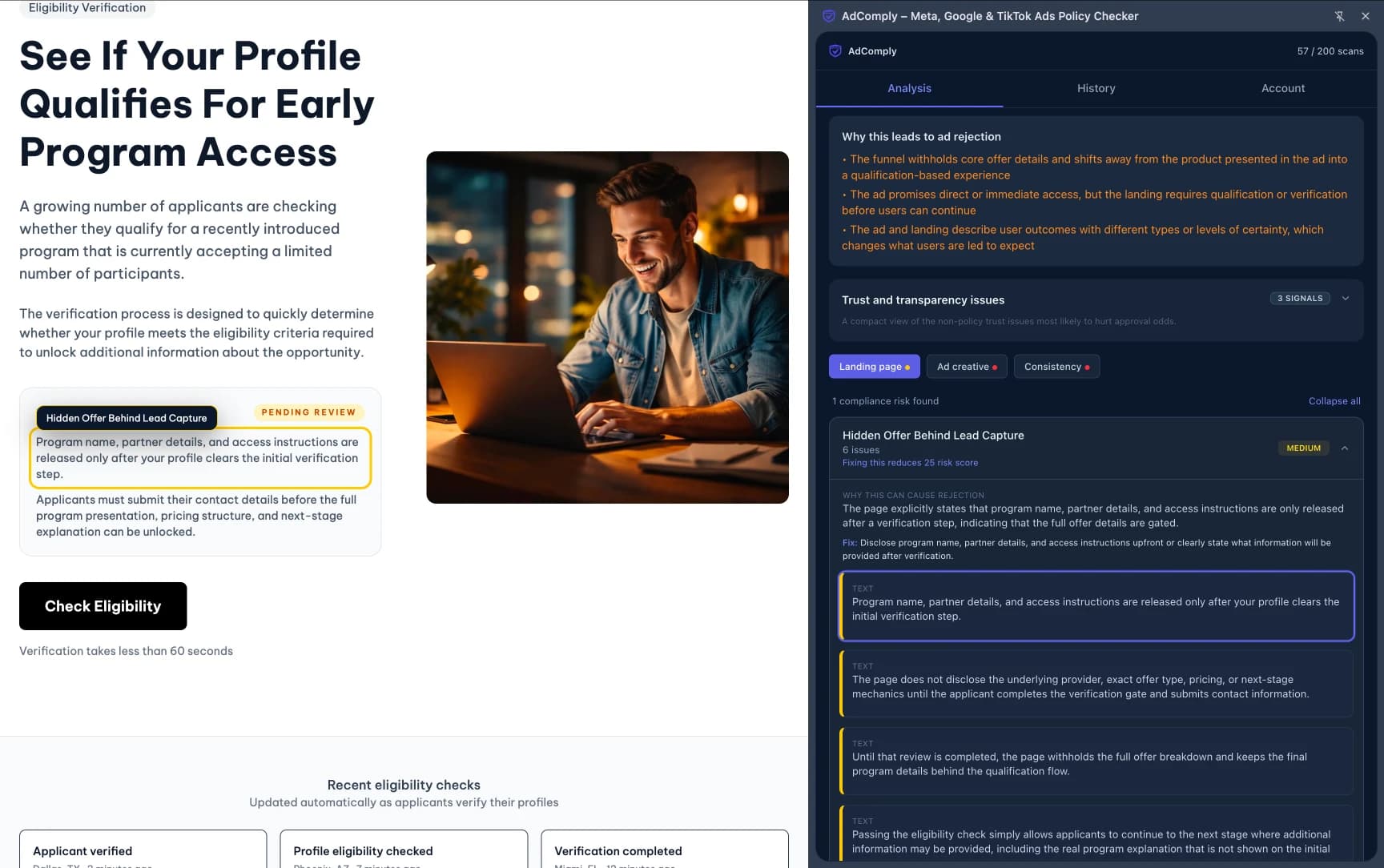
Another is aggressive funnel structure — especially anything that looks like a qualification step before explanation.
Then there are visual signals. Certain types of imagery — before/after transformations, fake dashboards, system-like interfaces — can trigger immediate flags, especially when combined with suggestive copy.
And finally, there’s inconsistency. If your ad and landing page don’t align closely enough, that mismatch can be detected very early.
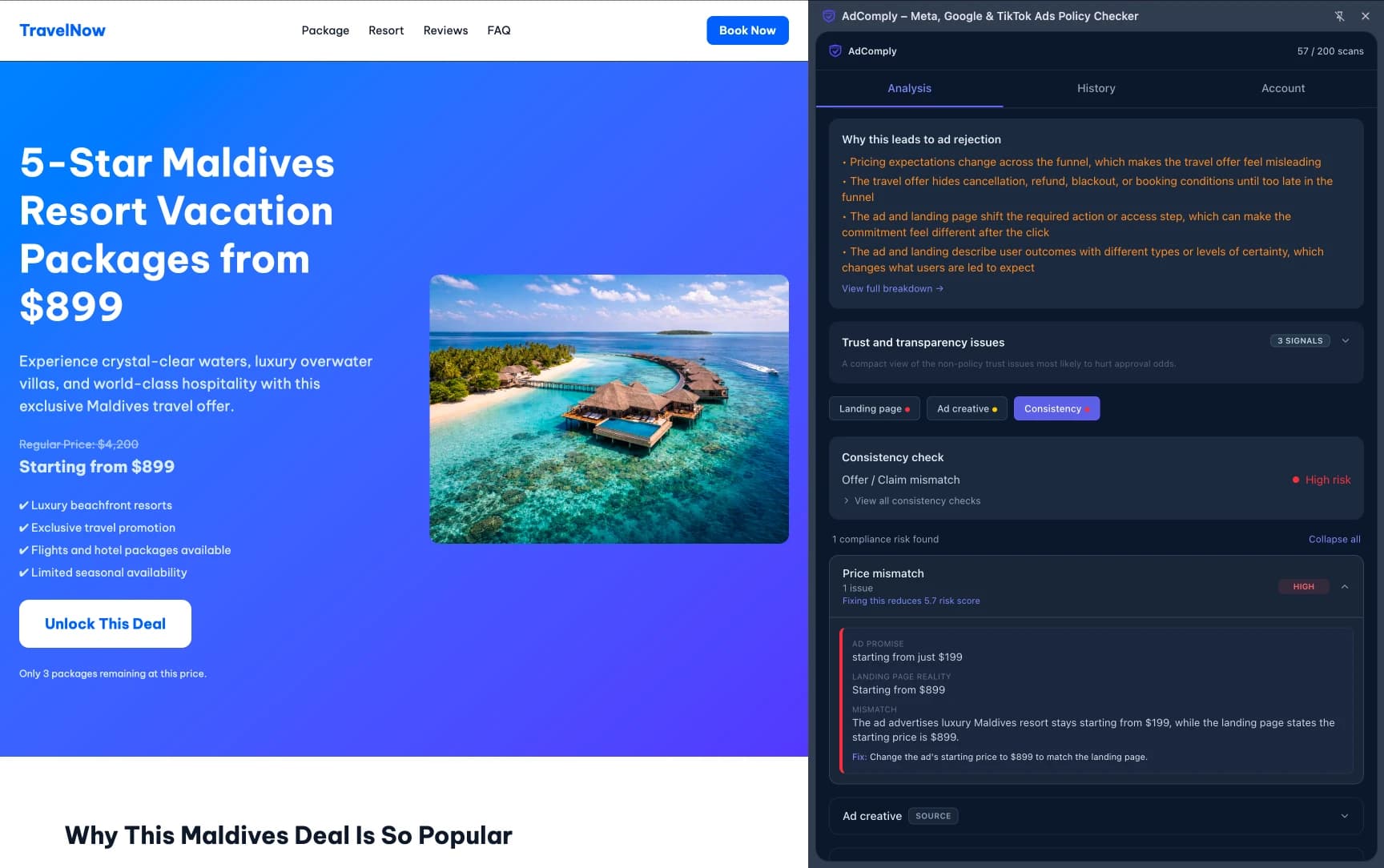
None of these are new individually. What makes instant rejection different is how quickly they’re detected.
Landing Page Structure (The Hidden Trigger)
If your ad gets rejected instantly, there’s a good chance the issue isn’t the ad itself — but rather one of the landing page mistakes that trigger rejections and get flagged before full review.
It’s the landing page.
Meta doesn’t wait for a full review to scan your page. It starts almost immediately, looking for structural patterns that correlate with risk.
This includes things like:
Whether the offer is explained clearly above the fold
Whether key information is hidden behind steps
Whether the page resembles known funnel structures
I’ve had cases where removing a single “Check Eligibility” step from the top of a page turned an instant rejection into a clean approval.
Nothing else changed. Same ad, same domain, same offer.
Find Rejection Risks Before You Submit
Scan your ad funnel for policy risks, risky claims, landing-page issues, and ad-to-page mismatches before review.
No signup required • instant results • 5 free scans included
That’s how sensitive this layer is to structure.
Why Qualification Funnels Get Flagged So Fast
Qualification funnels are one of the most reliable ways to trigger instant rejection.
Not because they’re inherently bad, but because they’re heavily associated with misleading flows in Meta’s data.
From the system’s perspective, a page that asks users to “check eligibility” before explaining what they’re getting looks risky by default.
It doesn’t evaluate your intent. It evaluates the pattern.
I’ve tested variations of the same funnel where simply moving the explanation of the offer above the qualification step reduced rejection rates dramatically.
That’s usually the difference between:
“Let me show you what this is, then ask you to proceed”
“Give me your input, then I’ll tell you what this is”
To a human, that difference feels minor. To the system, it’s significant.
Account and Domain Signals Matter More Than You Think
Another thing that becomes obvious over time is that your ad isn’t evaluated in isolation.
Your account history, your domain reputation, and even previous campaigns influence how your new ads are treated.
Before you launch: A quick scan can show the issues that often lead to ad rejection before you send the campaign for review.
Scan your funnel now →If your domain has been associated with high-risk patterns before, new ads pointing to it are more likely to get flagged early.
Same with accounts that have a history of rejections.
I’ve seen identical campaigns behave completely differently depending on which account they were launched from. That’s not coincidence.
It’s accumulated signal.
Why Fixing Copy Alone Often Doesn’t Work
A common reaction to instant rejection is to tweak the ad copy and try again.
Sometimes that helps, especially if the issue was purely phrasing. But in many cases, it doesn’t move the needle.
That’s because the system isn’t reacting to the copy in isolation. It’s reacting to the entire setup.
If the underlying structure remains the same, small copy changes won’t fix the core issue.
I’ve had ads go from rejected to approved only after changing the landing page — without touching the copy at all.
That’s usually a sign you were solving the wrong problem.
How to Diagnose an Instant Rejection Properly
When an ad gets rejected instantly, you need to approach it differently than a normal rejection.
Start by assuming it’s structural, not cosmetic.
Look at your landing page first. Is the offer clear immediately? Is anything important hidden behind interaction?
Then compare your ad and your page. Are you implying something in the ad that isn’t immediately visible on the page?
After that, check your funnel logic. Are you asking for input before providing clarity?
Only after that should you look at the copy.
This order matters more than people think.
What To Do When Your Ads Keep Getting Rejected Instantly
If you’re seeing repeated instant rejections, it’s usually a sign that your setup is consistently triggering the same pattern.
At that point, incremental fixes won’t help much.
You need to change something fundamental — usually the structure of your landing page or the way your offer is presented.
Simplifying often works better than optimizing.
Make the offer obvious. Remove steps. Reduce ambiguity.
It’s not about making the page “better”. It’s about making it easier for the system to classify it as safe.
How to Avoid Instant Rejections Going Forward
The goal isn’t to guess what Meta will flag next. It’s to build funnels that don’t resemble high-risk patterns in the first place.
That usually comes down to a few principles:
Align your ad and landing page closely
Explain the offer before asking for action
Avoid implied outcomes without context
Keep your structure simple and transparent
Once you start thinking in those terms, instant rejections become much less common.
And more importantly, they become predictable.
Because at that point, you’re not reacting to the system anymore.
You’re designing around it.