


There’s a very specific kind of frustration that only shows up when you’re running Facebook ads seriously: the moment your ad gets rejected, and the reason you’re given doesn’t actually help you fix anything.
You open the notification expecting something concrete. Instead, you get a vague label — “Circumventing Systems”, “Misleading Content”, sometimes just a generic policy reference that could apply to half the internet. You reread your ad. You check your page. Nothing obviously wrong.
And yet — rejected.
I’ve had days where the exact same structure was approved in the morning and rejected by the afternoon. Same copy, same funnel, just slightly different context. That’s usually the moment when you realize this isn’t about “rules” in the way most people think.
If your Facebook ad was rejected without a clear explanation, it’s not random — it’s part of a broader pattern of how Facebook ads get rejected across different setups. But it’s also not as simple as “you broke policy X”.
You’re dealing with a system that doesn’t explain itself well — and doesn’t need to.
Why Facebook Ads Get Rejected Without a Clear Reason
Meta’s official explanation is straightforward: ads are reviewed against advertising policies. That part is true. The part they don’t really spell out is how those decisions are actually made.
Most rejections today are not the result of someone manually reading your ad and deciding it’s not compliant. They come from automated systems that look for patterns — not violations in isolation.
Your ad isn’t judged on its own. It’s evaluated alongside your landing page, your domain history, how your funnel behaves, and how similar setups have performed or been flagged in the past.
So when you see a rejection message, what you’re getting is basically a category label. Not the root cause. Not the exact trigger. Just the bucket your setup fell into.
That’s why the explanation feels disconnected from reality. Because it often is.
I’ve seen “misleading content” triggered by something as small as phrasing that felt slightly more confident than what the landing page actually supported. Nothing dramatic — just enough of a gap.
The system doesn’t care if you intended to mislead. It cares whether the signals match.
It’s Usually Not the Ad (Even Though It Looks Like It)
One of the biggest mistakes people make is focusing entirely on the ad creative when something gets rejected.
It feels logical. That’s the thing you submitted. That’s the thing that got flagged. But in a lot of cases, the ad is just the entry point.
The real decision is happening on the landing page — often due to landing page mistakes that trigger ad rejections even when the ad itself looks fine.
Meta crawls your page almost immediately. It looks at structure, messaging hierarchy, how quickly the offer becomes clear, whether key information is visible without interaction, and whether the overall flow matches what the ad suggested.
I’ve had situations where I swapped nothing but the URL — literally the same ad — and one version got approved instantly while the other got rejected within minutes. That’s when it becomes obvious where the real leverage is.
If the explanation doesn’t make sense, it’s usually because you’re looking in the wrong place.
Common Patterns Behind “No Explanation” Rejections
After you’ve seen enough of these, you start noticing that the same few patterns come up again and again.
Not obvious violations. Not “this is clearly banned”. More like subtle misalignments that add up.
The first one is overpromising — not in an aggressive, scammy way, but in a slightly too-clean, slightly too-confident tone. Phrases that imply outcomes without really grounding them.
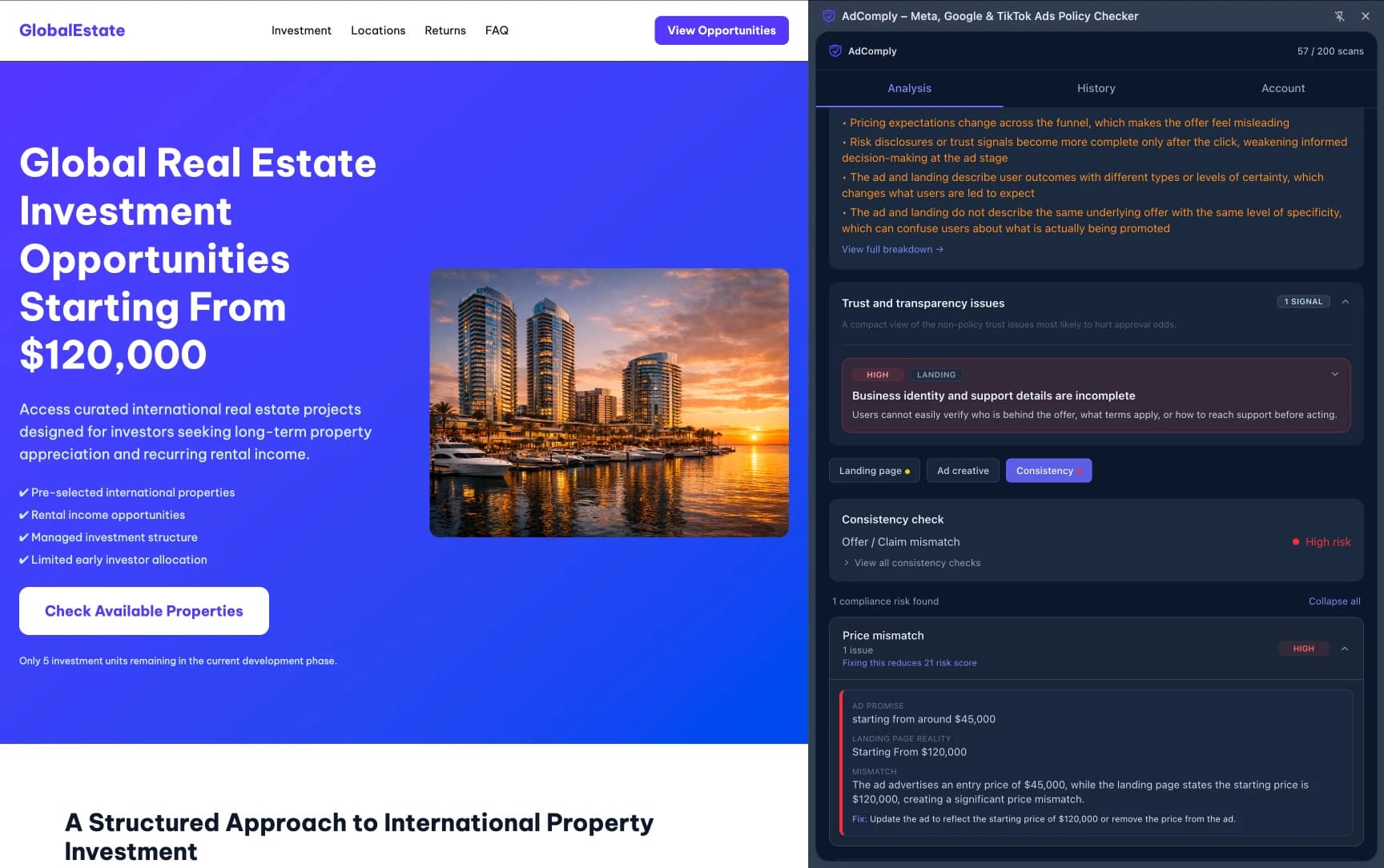
The second is inconsistency between the ad and the landing page. This one shows up everywhere. A price that’s technically correct but presented differently. A benefit that’s framed one way in the ad and another way on the page.
Individually, these things feel minor. Together, they look like a pattern.
And patterns are what the system reacts to.
Find Rejection Risks Before You Submit
Scan your ad funnel for policy risks, risky claims, landing-page issues, and ad-to-page mismatches before review.
No signup required • instant results • 5 free scans included
Then there’s funnel structure. This is where a lot of “mysterious” rejections actually come from.
Anything that asks the user to take a step before clearly explaining the offer — “check eligibility”, “unlock access”, “see if you qualify” — tends to get flagged much more aggressively than people expect.
Even when it’s legitimate.
Ad → Landing Page Mismatch (Where Things Quietly Break)
This is probably the most common issue that people underestimate.
Your ad says one thing. Your landing page says something close, but not identical. Maybe it’s the price. Maybe it’s how the offer is framed. Maybe it’s just the order in which information appears.
From a human perspective, it feels fine. From the system’s perspective, it’s a mismatch.
I’ve had campaigns where the ad mentioned a lower entry point — technically valid — but the landing page emphasized a higher starting price. That alone was enough to trigger a rejection after scaling spend.
What’s interesting is that these setups often pass initially. Then, once the campaign gains traction, they get re-evaluated and rejected later.
Before you launch: A quick scan can show the issues that often lead to ad rejection before you send the campaign for review.
Scan your funnel now →That’s usually not a coincidence. It just means more signals have been processed.
The system doesn’t interpret nuance. It compares what’s promised with what’s delivered. If there’s a gap, even a small one, it leans toward risk.
Why “Circumventing Systems” Shows Up (Even When You’re Not Doing Anything Wrong)
This is the one that throws people off the most.
“Circumventing Systems” sounds like you’re doing something deliberately deceptive. In most cases, that’s not what’s happening.
What’s actually happening is that your funnel looks similar to patterns that have been abused before.
Qualification flows are a good example. Pages that say “See if you qualify”, then ask for input before revealing what the offer actually is — those are heavily associated with low-quality or misleading funnels in Meta’s data.
So even if your offer is completely legitimate, the structure itself becomes the risk factor.

I’ve tested versions of the same funnel where simply moving the explanation of the offer above the “Check Eligibility” step reduced rejection rates dramatically.
Nothing about the offer changed. Just the order in which information was shown.
That’s the level at which these systems operate.
How to Actually Figure Out What Went Wrong
When the explanation doesn’t help, you have to approach this like a diagnosis, not a checklist.
The first step is to stop taking the rejection label literally. It’s not precise enough to guide your fix.
Instead, compare your ad and your landing page side by side. Not just the words, but the sequence. What does the user see first? What’s implied before anything is explained?
Then look at your funnel structure. Are you asking for an action before the user fully understands what they’re getting? If yes, that’s a likely trigger.
Check your trust signals too. This is one of those things people ignore because it feels secondary, but it stacks with everything else. No privacy policy, no clear contact info — on their own, maybe fine. Combined with other signals, they push you over the edge.
One thing I’ve learned the hard way is that fixes are often smaller than expected. It’s rarely about rewriting everything. It’s about removing friction points the system interprets as risk.
What To Do Right After a Rejection
Your instinct will probably be to duplicate the ad and try again. And to be fair, sometimes that works — temporarily.
But if the underlying issue is still there, it usually comes back.
A more reliable approach is to isolate variables.
If you think it’s the landing page, test the same ad with a simplified version of the page. Strip it down, make the offer obvious immediately, remove anything that delays clarity.
If you think it’s the ad, simplify the copy. Remove anything that sounds like a promise and reframe it as a description.
Requesting a manual review can help in edge cases, but it’s not something you can rely on consistently. If the system flags the same pattern again, the outcome usually doesn’t change.
Why Ads Sometimes Get Approved First (And Rejected Later)
This is another one that feels random until you’ve seen it enough times.
An ad gets approved, starts running, maybe even performs well — and then suddenly gets rejected.
That’s not a mistake. It’s a second layer of evaluation kicking in.
Meta doesn’t rely on a single pass. It keeps analyzing as more data comes in. Engagement patterns, user behavior, deeper page scans — all of that can trigger a re-evaluation.
I’ve had campaigns run for hours before getting pulled. In one case, it happened right after a spike in traffic. That’s usually when more scrutiny is applied.
Approval just means “nothing triggered yet”. It doesn’t mean “this is fully compliant”.
How to Avoid This Going Forward
At some point, you stop trying to decode individual rejections and start designing your funnels in a way that avoids them altogether.
The biggest shift is thinking in terms of alignment instead of persuasion.
Your ad, your landing page, and your funnel should feel like the same conversation, not three slightly different versions of it.
Clarity beats cleverness here. The faster a user — and the system — understands what you’re offering, the lower your risk.
Avoid hiding key information behind steps. If something needs to be explained, explain it early.
And maybe the most practical takeaway: treat compliance as part of your build process, not something you deal with after rejection.
Because once you reach that point where things feel “predictable”, these vague rejection messages stop being frustrating.
They just become signals you know how to read.