


If you’ve ever had a Facebook ad rejected with a vague “personal attributes” warning, you know how frustrating it feels.
There’s no obvious claim. No bold promise. Nothing that looks risky at first glance.
And yet the ad gets blocked — sometimes instantly.
This is one of the most misunderstood areas of Meta’s advertising policy. Not because it’s complicated, but because it’s counterintuitive.
You’re not allowed to describe the user.
Even when what you’re saying is probably true.
That’s the part most advertisers struggle with.
Because good marketing is usually about speaking directly to a person’s situation.
But on Facebook, that same approach can get your ad rejected.
What “Personal Attributes” Actually Means
At a high level, the rule is simple:
You can’t imply that you know something about the user.
That includes:
Health conditions
Financial situation
Relationship status
Age or appearance
Personal struggles
The key word here is “imply”.
You don’t need to say something directly for it to trigger a violation.
Even a question can be enough.
“Struggling with weight?”
“Do you have debt?”
“Feeling insecure about your appearance?”
All of these assume something about the person reading the ad.
And that’s exactly what Meta is trying to prevent.
From their perspective, ads shouldn’t feel like they’re targeting an individual’s private situation.
They should feel broad, not personal.
Why This Policy Exists (And Why It’s So Strict)
This rule isn’t about copywriting style — it’s about user trust.
Meta doesn’t want people feeling like:
“How do they know this about me?”
“Why am I being targeted like this?”
Even if your targeting is completely legitimate, the perception matters.
And perception is what the system is optimized for.
I’ve seen ads get rejected not because they were aggressive, but because they felt too specific.
That’s the line you’re navigating here.
Example #1: Direct Identification
This is the most obvious violation.
The ad directly calls out the user:
“You are overweight”
“You have anxiety”
“You’re struggling financially”
These almost always get rejected instantly.
But most advertisers don’t write ads like this.
The real issue starts when the language becomes slightly softer — but still implies the same thing.
Example #2: Questions That Imply Personal State
This is where things get tricky.
Questions feel natural in ads.
They’re engaging. They pull attention. They make people think.
But they also assume something.
“Are you tired of feeling out of shape?”
“Do you struggle to pay your bills?”
“Not happy with how you look?”
From a copywriting perspective, these are standard.
From Meta’s perspective, they’re risky.
Because they imply that the user is experiencing that issue.
I’ve had campaigns where removing a single question mark fixed the rejection.
Same message, different framing — completely different outcome.
Example #3: Before/After Framing That Feels Personal
This overlaps with misleading claims, but there’s an extra layer here.
Before/after images don’t just show results — they suggest identity.
They imply:
“This is you now”
“This could be you later”
That’s where the personal attribute issue comes in.
Even without text, the visual can create a personal inference.
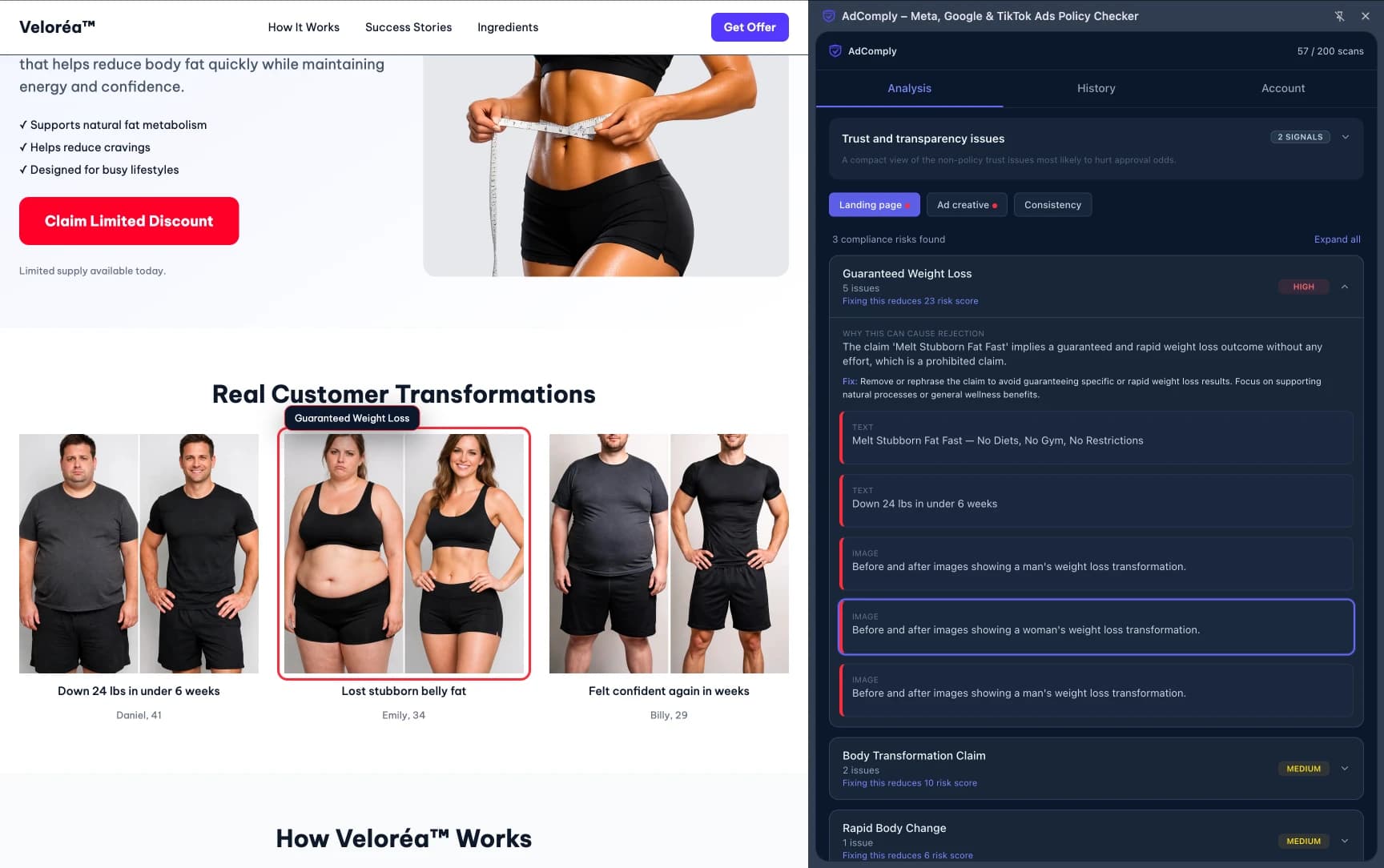
And if you combine that with copy like:
“Ready to transform your body?”
“Tired of looking like this?”
The system starts reading it as targeted messaging.
Not just a general offer.
Example #4: Financial and Status Assumptions
This shows up a lot in finance, employment, and crypto ads.
Things like:
“Stuck in a low-paying job?”
“Tired of being broke?”
“Struggling to make ends meet?”
Again, nothing here is extreme.
But all of it assumes the user’s situation.
And that’s enough.
One thing I’ve noticed over time is that financial language gets flagged faster than most other categories.
Probably because it touches on sensitive personal data.
Example #5: Health and Body Language
This is one of the strictest areas.
Even mild wording can trigger issues:
“Lose belly fat fast”
“Fix your skin problems”
“Eliminate back pain”
The problem isn’t just the claim.
It’s the implication that the user has that condition.
And that’s enough for rejection.
I’ve seen ads pass after changing “Lose weight fast” to “Weight loss support program”.
Same intent. Completely different compliance outcome.
Why These Violations Feel Random
This is the part that confuses most people.
You run one ad — rejected.
You tweak a word — approved.
It feels inconsistent.
If you’ve seen this happen before, it’s part of a broader pattern of how Facebook ads get rejected across different categories.
But what’s actually happening is pattern detection.
The system isn’t just looking at one sentence.
It’s looking at tone, phrasing, structure, and context.
A single line might be fine on its own.
But combined with other signals, it crosses the threshold.
That’s why small changes can have a big impact.
Find Rejection Risks Before You Submit
Scan your ad funnel for policy risks, risky claims, landing-page issues, and ad-to-page mismatches before review.
No signup required • instant results • 5 free scans included
How to Fix Personal Attribute Violations
The goal isn’t to remove personalization.
It’s to shift how you frame it.
Instead of talking about the user, talk about the situation.
❌ “Struggling with weight?”
✅ “Weight loss programs designed for busy people”
❌ “Tired of being broke?”
✅ “Ways to build additional income streams”
❌ “Not happy with your skin?”
✅ “Skincare solutions for different skin types”
It’s a small shift, but it changes everything.
You’re no longer making assumptions.
You’re presenting options.
A Practical Way to Check Your Ads
One simple test I use:
Read your ad and ask:
“Am I describing the user, or the problem?”
If it feels like you’re talking about “them” directly, it’s probably risky.
If it feels like you’re describing a general situation, you’re usually safe.
That distinction sounds subtle, but it’s what the system is trained to detect.
And once you start seeing it, you can’t unsee it.
Where Most Advertisers Still Get It Wrong
Even after understanding the rule, people tend to make the same mistake:
They fix the headline — but leave the rest.
Body text, images, testimonials — all of these can still imply personal attributes.
That’s why some ads keep getting rejected even after “fixing” the obvious part.
The issue isn’t one line.
It’s the overall signal.
And that’s something you only start noticing when you look at the whole funnel, not just the ad.
That’s also where automated analysis tools tend to catch patterns that are easy to miss manually — especially across longer pages and combined signals.
Before you launch: A quick scan can show the issues that often lead to ad rejection before you send the campaign for review.
Scan your funnel now →Final Takeaway
Personal attribute violations aren’t about being aggressive.
They’re about being too specific.
Once you shift from “you” to “the situation”, most of these issues disappear.
And your ads start feeling more natural anyway.
Not less personal — just less intrusive.
And that’s exactly what Meta is optimizing for.