


“Misleading claims” is probably the most overused — and least understood — reason behind Facebook ad rejections.
Everyone knows you can’t promise unrealistic results. That part is obvious. But what most advertisers underestimate is how often completely normal, even conservative copy gets flagged as misleading.
Not because it’s false — but because of how it’s interpreted in context.
In 2026, Meta doesn’t evaluate claims in isolation. It looks at how they connect to your landing page, your funnel, and the expectations you’re setting for the user.
That’s why two nearly identical ads can have completely different outcomes. One gets approved. The other gets rejected within seconds.
The difference usually isn’t the claim itself.
It’s the pattern behind it.
What Facebook Actually Considers a “Misleading Claim”
Most people think misleading claims are about lying.
In reality, they’re about expectations.
If your ad creates an expectation that the landing page doesn’t clearly support, explain, or contextualize, the system treats that as misleading — even if the claim is technically true.
For example, “Improve your results with AI automation” sounds harmless.
But if the landing page doesn’t explain what “improve” means, how it works, or what kind of results are realistic, the claim starts to look vague or inflated.
And vague claims are often treated the same as exaggerated ones.
That’s where most advertisers get caught.
Example #1: Implied Outcomes Without Context
This is one of the most common patterns I see across SaaS and marketing tools.
The ad doesn’t promise anything extreme. It just implies improvement.
Something like:
“Boost your workflow efficiency”
“Optimize your campaigns with AI”
“Increase conversions without extra effort”
Individually, these look fine.
But when the landing page doesn’t define what those outcomes actually mean, they become problematic.
I’ve seen ads get rejected simply because the landing page stayed too high-level.
No numbers. No explanation. No mechanism.
From a human perspective, that’s just marketing.
From the system’s perspective, it’s an unsupported claim.
And unsupported claims fall into the misleading category.
Example #2: “Instant Results” Framing
This one is subtle, and it shows up everywhere.
Words like “instant”, “immediate”, or “in seconds” aren’t always prohibited — but they’re risky.
Especially when they imply a result, not just an action.
“Get started instantly” is fine.
“See results instantly” is a different story.
The system reads that as a promise of outcome speed.
And unless your landing page clearly explains what “instant” refers to, it gets flagged.
I’ve had campaigns where changing one word — from “instant results” to “instant access” — made the difference between rejection and approval.
That’s how sensitive this category is.
Example #3: Ad → Landing Page Disconnect
This is where most misleading claim violations actually come from.
Not from the claim itself, but from the mismatch between what the ad suggests and what the page delivers.
Let’s say your ad says:
“Start from $199”
And your landing page shows:
“Packages from $899”
Even if both are technically correct (different tiers, conditions, etc.), the system sees inconsistency.
And inconsistency gets interpreted as misleading.
From the system’s perspective, the user expectation is broken.
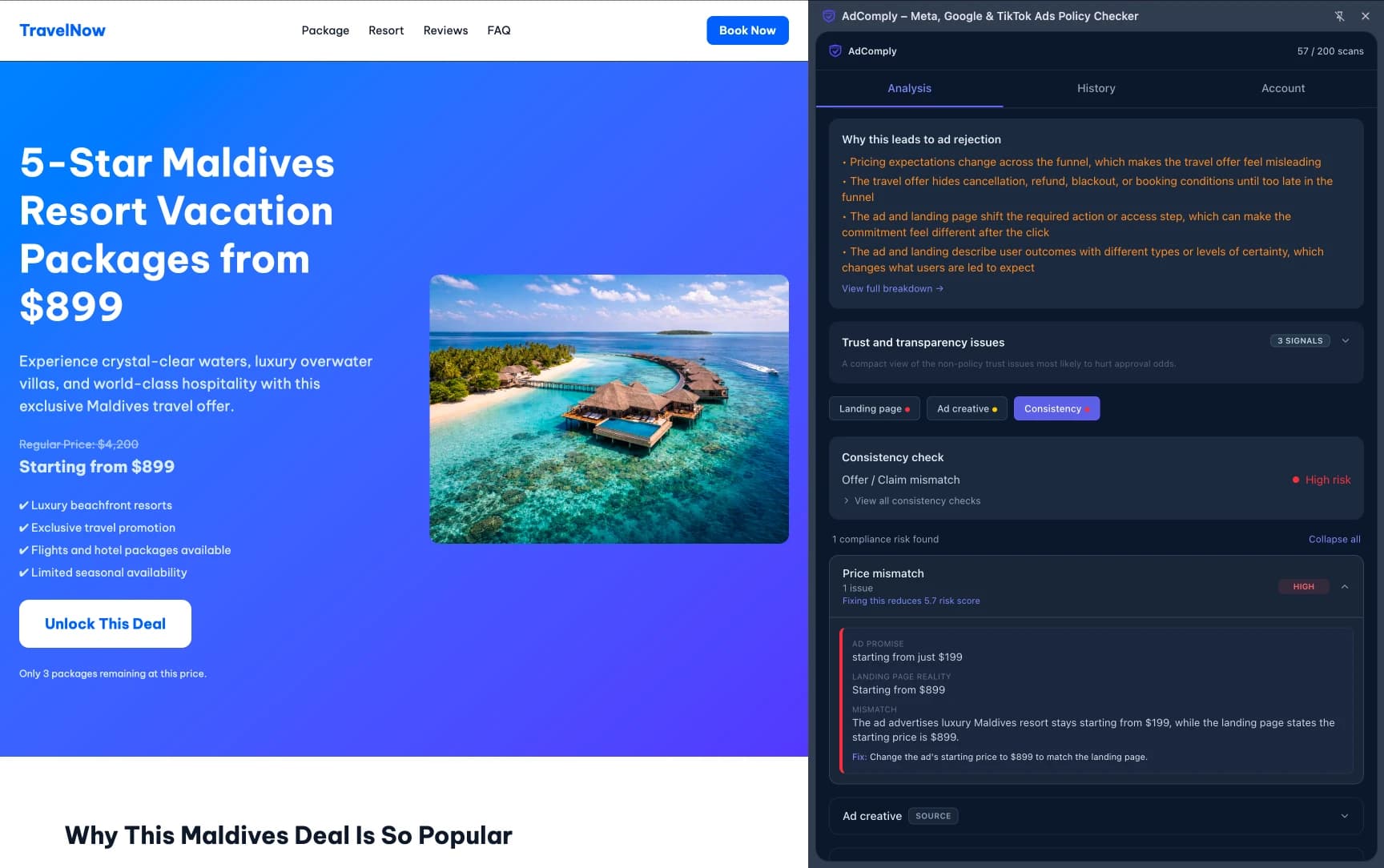
That’s why this type of rejection often feels confusing. Nothing looks “wrong” in isolation.
Find Rejection Risks Before You Submit
Scan your ad funnel for policy risks, risky claims, landing-page issues, and ad-to-page mismatches before review.
No signup required • instant results • 5 free scans included
But the connection between elements tells a different story.
These inconsistencies are rarely obvious at a glance, especially across longer pages. This is a common issue in landing page mistakes that trigger ad rejections, where small gaps between messaging and content create compliance risks. Automated checks that compare ad messaging with landing content can surface these issues almost instantly.
Example #4: Vague Programs and Undefined Offers
This is extremely common in lead generation funnels.
Ads talk about:
“exclusive programs”
“early access opportunities”
“limited spots available”
But the landing page never clearly explains what the program actually is.
Instead, users are asked to “check eligibility” or “start verification”.
From a marketer’s perspective, this is just funnel optimization.
From the system’s perspective, it looks like information is being intentionally withheld.

And that’s where it crosses into misleading territory.
That’s why these funnels get rejected even when the underlying offer is legitimate.
The issue isn’t what you’re offering.
It’s how you’re presenting it.
Patterns like this are often hard to spot manually, especially when the funnel “feels normal” from a marketing perspective. This is exactly where automated compliance analysis tends to surface hidden risk signals early.
Example #5: Overpromising Through Design
Not all misleading claims are written.
Some are visual.
Things like:
Dashboard interfaces that look like real-time results
Graphs showing unrealistic growth
Before/after comparisons
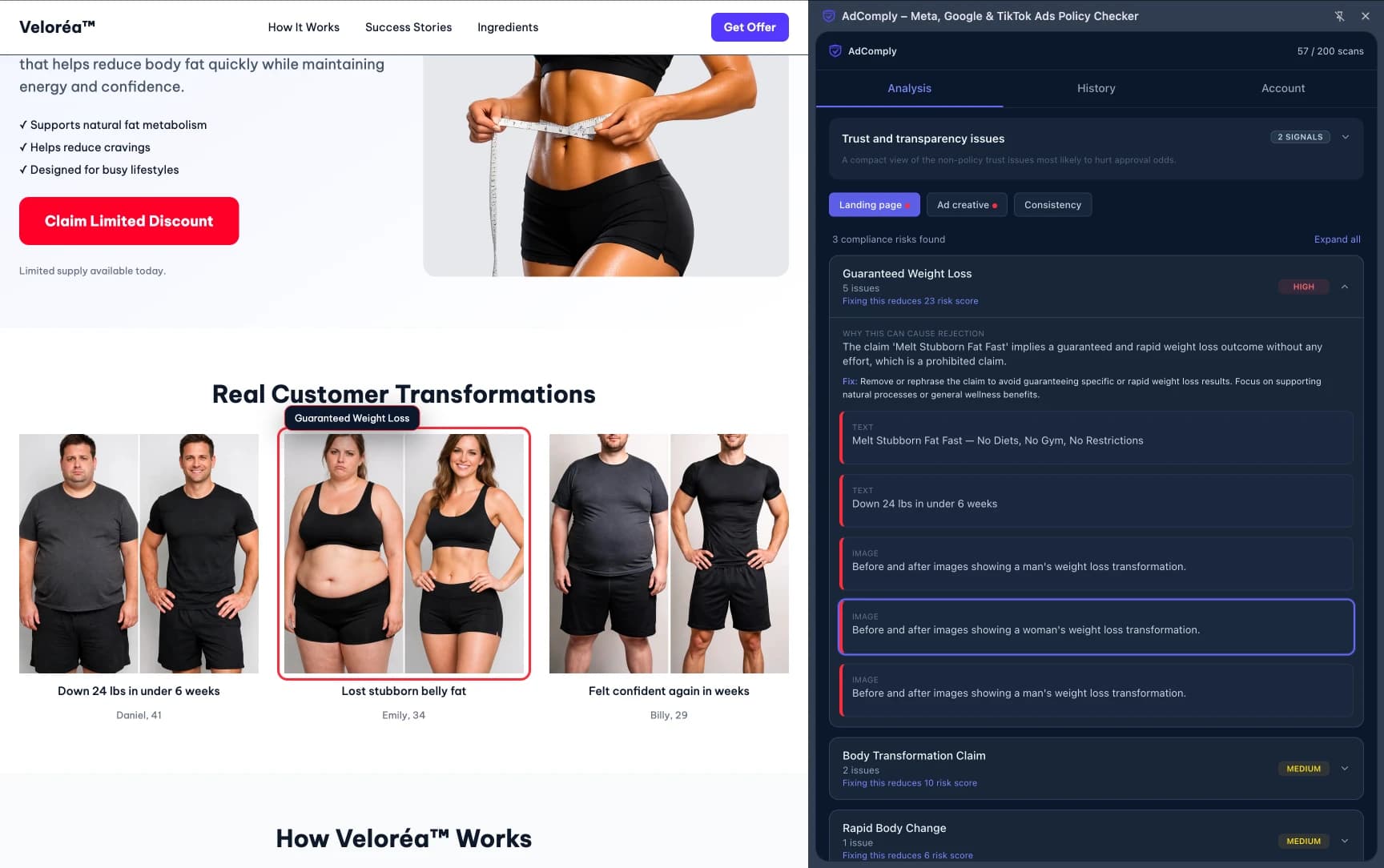
Even if your copy is neutral, these visuals can imply outcomes that aren’t actually guaranteed.
Before you launch: A quick scan can show the issues that often lead to ad rejection before you send the campaign for review.
Scan your funnel now →I’ve seen ads get rejected purely because of how the product was presented visually.
Remove the image, keep the same text — approved.
That’s when you realize the system is interpreting signals far beyond words.
Some tools now analyze visual patterns specifically — detecting UI simulations, transformation imagery, and other high-risk elements before submission.
Why These Violations Feel Random (But Aren’t)
One of the most frustrating things about misleading claim rejections is how inconsistent they feel.
You run the same ad twice — one passes, one doesn’t.
You tweak a headline — suddenly it works.
It feels random.
But it’s not. What you’re seeing is part of a broader pattern of how Facebook ads get rejected across different categories.
What’s actually happening is signal accumulation.
A slightly vague claim + a slightly unclear landing page + a slightly aggressive funnel.
Each on its own might pass.
Together, they cross the threshold.
And once you understand that, the system becomes much more predictable.
How to Fix Misleading Claim Issues Before They Happen
The goal isn’t to “remove all claims”.
It’s to support them properly.
Define what your claim actually means
Make sure the landing page explains it clearly
Avoid implying outcomes you don’t explicitly show
Keep messaging consistent across ad and page
If your ad says something, the landing page should reinforce it within seconds.
Not after scrolling. Not after clicking. Immediately.
That’s the difference between a strong claim and a misleading one.
And in 2026, that difference is what decides whether your ad runs or gets rejected.