


If you’ve been running Facebook ads for a while, you’ve probably noticed something frustrating: the rules didn’t really get stricter — they got smarter.
In 2026, most ad rejections aren’t about obvious violations anymore. You don’t need to promise “lose 10kg in 3 days” to get flagged. You can follow what feels like best practices and still get rejected.
That’s because Meta’s system is no longer looking for individual phrases or isolated claims. It’s evaluating patterns — across your ad, your landing page, your funnel, and even your past campaigns.
And once you start looking at rejections through that lens, the most common policy violations begin to make a lot more sense.
This isn’t a list of policy sections copied from Meta’s docs. It’s what actually shows up in real campaigns — the patterns that consistently trigger rejections, often instantly.
Why Most “Violations” Aren’t What You Think
One of the biggest misconceptions is that ads get rejected because of a specific word or sentence.
Sometimes that’s true. But more often, the system is reacting to how everything fits together.
You can have completely neutral copy, and still get rejected because the structure of your funnel looks like something the system associates with misleading behavior.
I’ve had campaigns where changing a single section on the landing page — without touching the ad — turned a rejected ad into an approved one.
That’s usually the moment when it clicks: the violation isn’t in one place. It’s in the pattern.
Misleading Claims (Even When They Sound Reasonable)
This is still one of the most common triggers, but it’s evolved.
It’s no longer about obvious exaggerations. It’s about implied outcomes.
Phrases like “improve your results”, “optimize performance”, or “increase conversions” can be fine — until they’re placed in a context that makes them sound guaranteed or effortless.
The system looks at how those claims connect to your landing page. If the page doesn’t clearly support or explain them, they start to look misleading.
I’ve seen ads get rejected not because of what they said, but because the landing page didn’t clarify the claim fast enough.
That’s where most people get caught off guard.
Ad → Landing Page Mismatch
This is probably the most underestimated violation — and one of the fastest ways to get rejected.
It doesn’t have to be a blatant contradiction. Small inconsistencies are enough.
Different pricing, missing features, slightly different positioning — all of these can create a mismatch signal.
From the system’s perspective, inconsistency equals risk — especially in common landing page mistakes that trigger ad rejections, where small gaps between messaging and content create compliance issues.
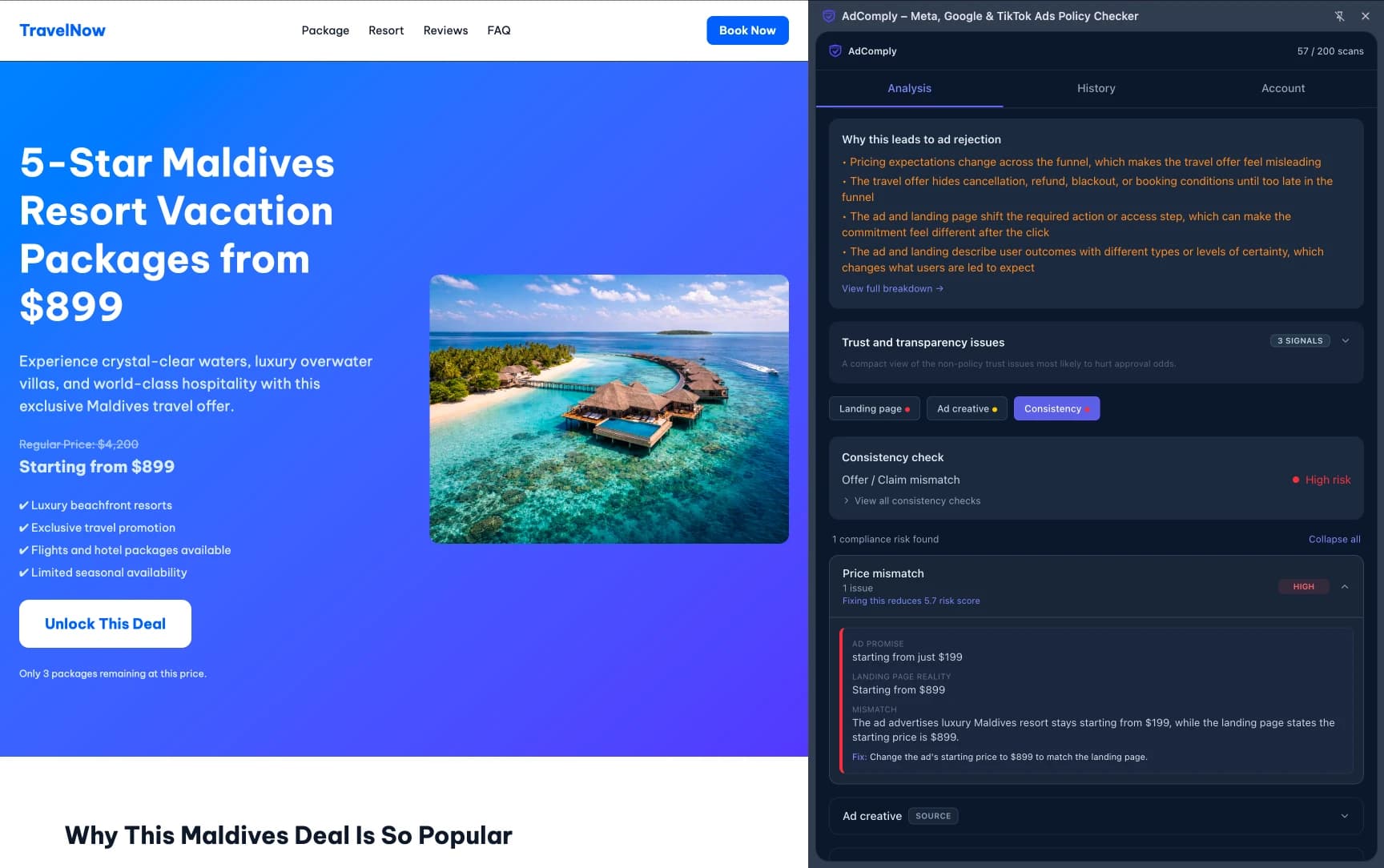
And the detection happens early. In many cases, within seconds of submission.
I’ve tested campaigns where everything looked compliant individually, but the combination of ad + landing created a mismatch that triggered instant rejection.
Once you start aligning those two more tightly, rejection rates drop almost immediately.
Hidden or Delayed Offer Disclosure
This one shows up constantly, especially in lead generation funnels.
If a user has to click, scroll, or input information before understanding what the offer actually is, the system treats that as a risk.
It doesn’t matter if the offer is legitimate. The structure itself is what gets flagged.
A page that says “Check if you qualify” without clearly explaining what you’re qualifying for will almost always perform worse in review.
I’ve had funnels where simply moving the explanation above the CTA reduced rejection rates dramatically.
Find Rejection Risks Before You Submit
Scan your ad funnel for policy risks, risky claims, landing-page issues, and ad-to-page mismatches before review.
No signup required • instant results • 5 free scans included
To a human, this feels like a small UX change. To the system, it’s a completely different pattern.
“Circumventing Systems” (The Most Misunderstood One)
This is the violation people hate the most, because it often shows up without a clear explanation.
What it usually means in practice is that your funnel resembles known deceptive patterns — even if you’re not trying to deceive anyone.
Qualification steps before explanation
Hidden offers behind lead capture
Vague or undefined program descriptions
The system doesn’t evaluate intent. It evaluates similarity.
If your setup looks like something that has historically been abused, it gets flagged.

That’s why this violation feels so unpredictable — but once you recognize the patterns, it becomes much easier to avoid.
Patterns like this are often hard to spot manually, especially when the funnel “looks normal” from a marketing perspective. This is exactly where automated compliance analysis tends to catch issues earlier than manual review.
Fake System or UI Simulation
This one has become more common with the rise of AI and automation tools.
Ads that simulate dashboards, scan results, or system notifications can trigger flags if they imply real-time analysis that isn’t actually happening.
Before you launch: A quick scan can show the issues that often lead to ad rejection before you send the campaign for review.
Scan your funnel now →Even subtle cues like “Scan complete” or “3 issues detected” can be interpreted as misleading if they’re not backed by real functionality.
I’ve seen clean-looking SaaS ads get rejected simply because they looked too much like a system interface.
It’s not about the design itself — it’s about what the design implies.
Missing Trust Signals (Still Underrated)
This isn’t always flagged as a direct violation, but it heavily influences rejection risk.
Privacy policy and terms pages
Clear contact information
Basic legal transparency elements
Consistent branding across the entire funnel
Brand inconsistency is one of those signals people overlook. When the ad feels polished and modern, but the landing page looks outdated or disconnected, it creates a trust gap — and the system tends to interpret that as risk.
Pages without clear trust signals are more likely to be treated as risky, especially in sensitive categories like finance, real estate, or health.
I’ve had cases where adding basic legal pages didn’t just improve approval rates — it reduced instant rejections.
It’s not a magic fix, but it shifts how the system classifies your page.
Visual Signals That Trigger Risk
Images matter more than most people think.
Certain visual patterns are strongly associated with violations:
Before/after transformations
Luxury lifestyle imagery tied to outcomes
Fake notifications or UI elements
Exaggerated results visuals
Even if your copy is compliant, these visuals can push your ad into a higher-risk category.
I’ve seen ads pass after removing a single image — without changing anything else.
In many cases, the issue isn’t obvious to the eye. Certain visual patterns — even subtle ones — are strongly associated with past policy violations.
Our visual analyzer detects 40+ high-risk imagery patterns that are commonly flagged during review, from transformation-style visuals to UI-like interfaces.
Stacking Signals (Why One Issue Becomes a Rejection)
Most rejections don’t come from a single violation. They come from multiple weak signals stacking together.
A slightly vague claim + a slightly unclear landing page + a slightly aggressive funnel structure.
Individually, each of these might pass.
Together, they cross the threshold.
This is why some ads feel “randomly rejected” — but they’re not random. They’re cumulative.
Once you start reducing those signals, approvals become much more consistent.
How to Actually Avoid These Violations
Trying to memorize policy rules doesn’t help much in practice.
What works better is thinking in patterns.
Is the offer immediately clear?
Does the ad match the landing page exactly?
Am I asking for action before providing context?
Does anything look exaggerated or implied?
If you can answer those questions confidently, you’re already ahead of most advertisers.
Because at that point, you’re not trying to “pass review”.
You’re building something that naturally looks compliant.
And that’s the real shift in 2026.