


There’s a point most advertisers hit sooner or later.
You read the policies. You clean up your copy. You remove anything that looks even remotely aggressive. You double-check your targeting, your visuals, your claims.
You hit publish expecting a smooth approval.
And then — rejected.
No obvious violation. No dramatic claim. Nothing that clearly breaks the rules.
Just a quiet rejection that doesn’t seem to match what you actually built.
This is where a lot of people get stuck, because it challenges a basic assumption: that following policy should be enough.
In practice, it isn’t.
Because Meta doesn’t evaluate ads the way most people expect. It doesn’t just check for compliance. It tries to predict risk.
And that difference changes everything.
Why “Following Policy” Doesn’t Guarantee Approval
Most advertisers approach Facebook ads with a rule-based mindset.
Don’t make unrealistic claims. Don’t use prohibited content. Don’t violate targeting restrictions.
All of that still matters. But it’s no longer the deciding factor in many cases.
In 2026, the system is less about checking boxes and more about interpreting patterns.
Your ad isn’t reviewed as a standalone object. It’s evaluated as part of a larger structure — your landing page, your funnel, your domain, and even your historical behavior as an advertiser.
That means you can technically follow every visible rule and still trigger a rejection if the overall setup resembles something the system associates with risk.
I’ve had campaigns where nothing in the copy violated policy, but the structure of the funnel alone was enough to get flagged.
That’s usually the moment when it becomes clear: compliance is necessary, but it’s not sufficient.
The Shift from Rule-Based to Pattern-Based Review
To understand why compliant ads get rejected, you have to understand how the system has evolved.
It used to be more literal. Certain words triggered flags. Certain formats were more risky. If you avoided those, you were usually fine.
Now, the system operates differently.
It looks at how your ad behaves in context. What expectations it creates. How those expectations are fulfilled — or not — on the landing page.
It compares your setup to millions of previous campaigns. It looks for similarities to patterns that historically led to low-quality experiences or policy violations.
And it makes a decision based on probability, not certainty.
This is why two ads that look nearly identical can have completely different outcomes.
One fits within a “safe” pattern. The other doesn’t.
If you’ve seen that happen before, it’s part of a broader pattern of how Facebook ads get rejected across different categories and setups.
It’s Not What You Say — It’s What You Imply
One of the most common reasons compliant ads get rejected is that they imply more than they explicitly state.
You might write something like “Improve your results with AI automation.”
On its own, that’s harmless. It doesn’t promise anything unrealistic.
But if your landing page doesn’t clearly define what “improve” means, how it works, or what kind of results are typical, the system may interpret that as an unsupported claim.
The issue isn’t the wording. It’s the gap between expectation and explanation.
I’ve seen ads pass immediately after adding a single clarification section to the landing page — without changing the ad at all.
That’s how sensitive the system is to implied meaning.
Ad → Landing Page Alignment (Where Most Issues Start)
If there’s one area where compliant ads consistently fail, it’s alignment.
Your ad sets an expectation. Your landing page is supposed to fulfill it.
When those two don’t match closely enough, the system treats it as a risk — even if both elements are individually acceptable.
This doesn’t have to be obvious.
A slightly different price. A benefit framed differently. A missing detail that only appears after scrolling.
From a human perspective, these feel minor. From the system’s perspective, they break consistency.
And inconsistency is one of the strongest signals associated with misleading behavior.
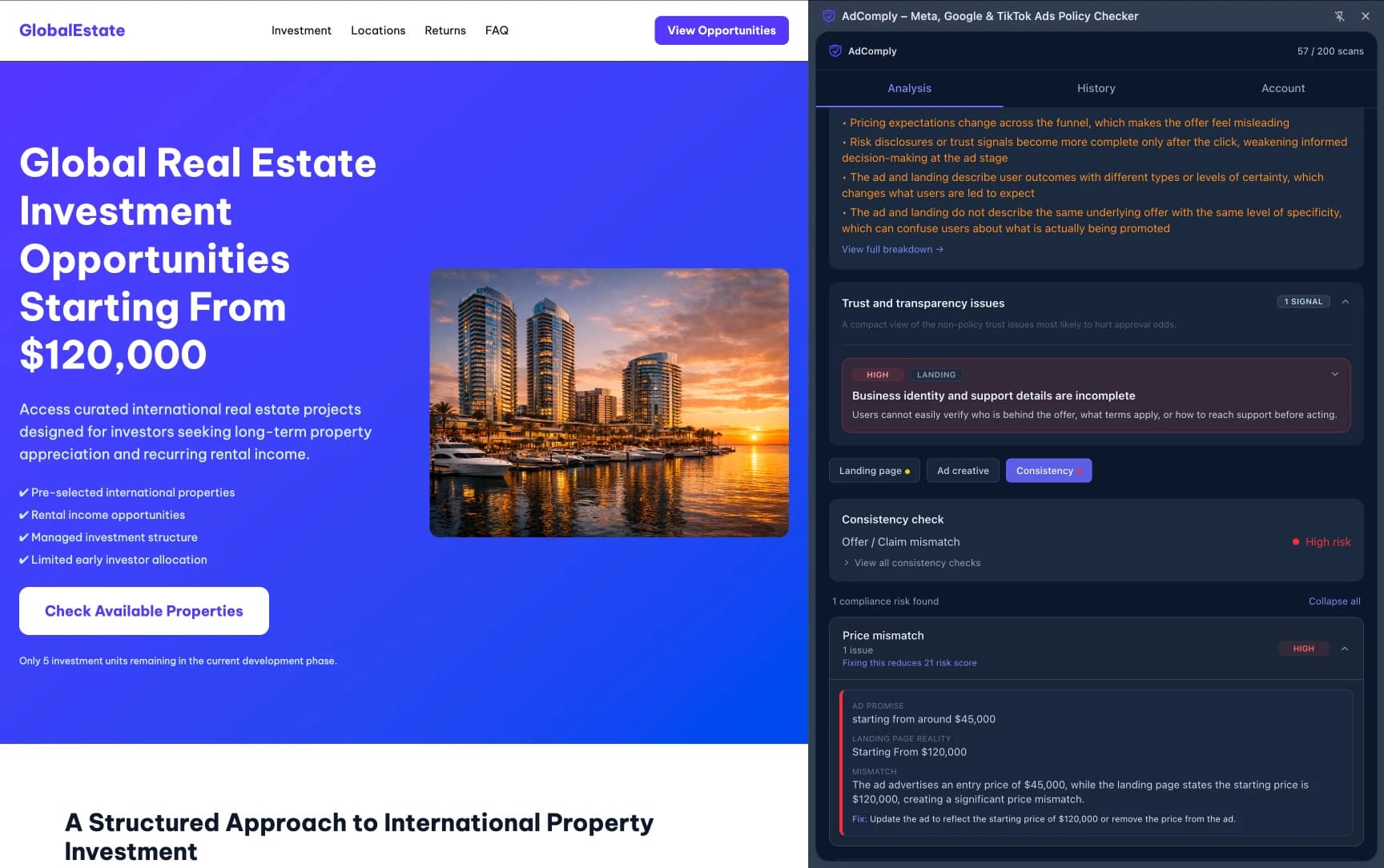
This is exactly the kind of issue covered in landing page mistakes that trigger ad rejections, where small gaps between messaging and structure create outsized risk.
I’ve had campaigns where aligning a single line between the ad and the landing page reduced rejection rates significantly.
No major rewrite. Just tighter alignment.
Funnel Structure Can Override “Compliant” Copy
Another thing that surprises people is how much structure matters.
Find Rejection Risks Before You Submit
Scan your ad funnel for policy risks, risky claims, landing-page issues, and ad-to-page mismatches before review.
No signup required • instant results • 5 free scans included
You can have perfectly compliant copy and still get rejected because of how your funnel is designed.
For example:
Asking users to “check eligibility” before explaining the offer
Hiding key information behind a form or interaction
Using a multi-step flow where the value isn’t immediately clear

None of these are explicitly banned.
But they’re strongly associated with patterns that have historically been abused.
So the system treats them as risky by default.
I’ve tested variations where simply moving the explanation above the first interaction dramatically improved approval rates.
Nothing about the offer changed. Just the order of information.
Why “Safe” Copy Still Triggers Rejection
There’s a common instinct to make copy more conservative after a rejection.
Remove strong wording. Tone everything down. Avoid anything that sounds like a claim.
Sometimes that helps.
But often, it doesn’t fix the underlying issue.
That’s because the system isn’t just evaluating the intensity of your language. It’s evaluating how your message connects to everything else.
I’ve seen ads with extremely neutral copy get rejected because the landing page implied outcomes more aggressively.
And I’ve seen the opposite — stronger copy pass because the landing page supported it clearly.
Before you launch: A quick scan can show the issues that often lead to ad rejection before you send the campaign for review.
Scan your funnel now →The takeaway is simple: tone alone doesn’t determine risk.
Context does.
Visual Signals Matter More Than You Think
Another factor that often gets overlooked is visual context.
You might have compliant text, but the imagery tells a different story.
Before/after transformations, dashboard simulations, lifestyle imagery tied to outcomes — all of these can imply results that your copy doesn’t explicitly state.
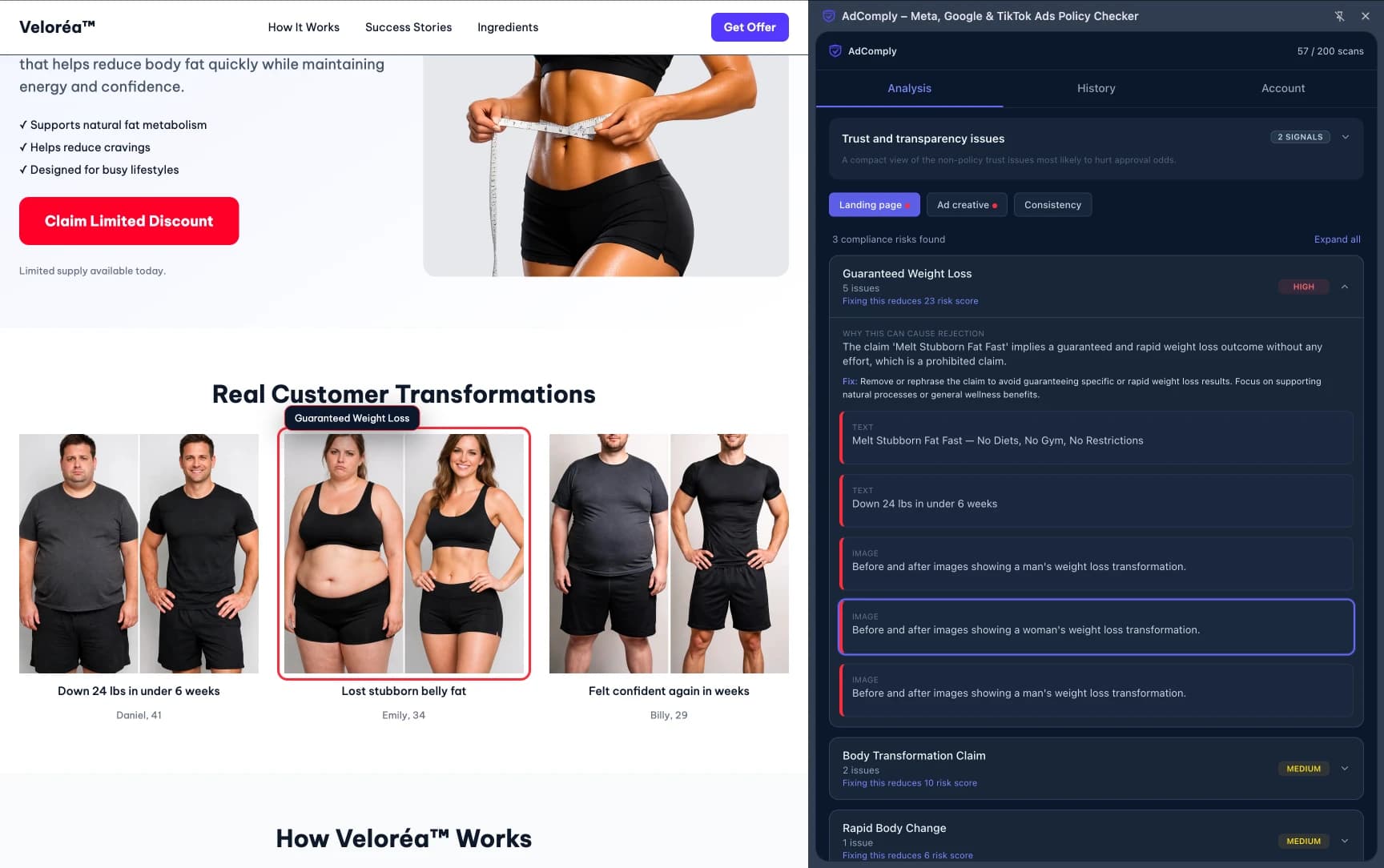
The system evaluates those signals together.
The system’s computer vision identifies UI elements that look like system alerts or fake interactivity. Even if your text is 100% compliant, the “visual grammar” of your ad can trigger an automated rejection.
I’ve had ads rejected purely because of an image that suggested performance improvements, even though the copy was neutral.
Remove the image, keep everything else the same — approved.
That’s when it becomes clear that compliance isn’t just about words.
Account and Domain History Change the Outcome
Two advertisers can run the same campaign and get different results.
Not because of the ad itself, but because of the account behind it.
Meta tracks historical behavior. If your account or domain has been associated with higher-risk patterns before, new ads are more likely to be scrutinized earlier and more aggressively.
This doesn’t mean you’re penalized permanently. But it does influence how quickly the system flags potential issues.
I’ve seen identical campaigns behave differently across accounts, and the only variable was historical signal.
That’s not something you can fix with copy.
It’s something you have to account for.
Signal Stacking (Why Small Issues Add Up)
Most rejections don’t come from a single clear violation.
They come from multiple weak signals that stack together.
A slightly vague claim. A slightly unclear landing page. A slightly aggressive funnel structure.
Each one on its own might pass.
Together, they cross a threshold.
This is why compliant ads still get rejected.
Because compliance tends to focus on individual elements, while the system evaluates the combination.
Once you start thinking in terms of signal accumulation, the behavior of the system becomes much more predictable.
Why It Feels Inconsistent (But Isn’t)
One of the most frustrating parts of this process is how inconsistent it feels.
You run one version — rejected. You tweak something small — approved.
It feels random.
But it isn’t.
What’s happening is that your changes are shifting the overall signal profile of your setup.
You’re moving from “just over the threshold” to “just under it”.
The system isn’t flipping a coin. It’s recalculating risk based on the signals it sees.
Once you understand that, these outcomes start to make more sense.
How to Actually Reduce Rejection Risk
If following policy isn’t enough, what actually works?
The answer is alignment and clarity.
Make sure your ad and landing page say the same thing
Explain the offer immediately, not after interaction
Support every implied claim with visible context
Avoid structures that resemble known high-risk funnels
It’s less about avoiding mistakes and more about reducing ambiguity.
The easier it is for the system to understand what you’re offering, the lower your risk.
What Changes When You Think in Patterns
There’s a shift that happens once you stop thinking in terms of rules and start thinking in terms of patterns.
You stop asking, “Is this allowed?”
And start asking, “What does this look like to the system?”
You stop optimizing for persuasion alone, and start optimizing for clarity.
You stop treating compliance as a checklist, and start treating it as part of your structure.
That’s when things become more predictable.
Because at that point, you’re not just trying to pass review.
You’re building something that naturally fits within how the system evaluates risk.
And that’s the real difference between ads that consistently get approved and ads that don’t.