


One of the biggest misconceptions in advertising is that “safe” landing pages look boring.
People imagine compliant funnels as stripped-down pages with weak copy, no persuasion, and zero conversion psychology.
That’s usually not true.
I’ve seen high-performing landing pages pass Facebook review consistently while still converting aggressively.
The difference wasn’t that they avoided marketing.
The difference was structural balance.
Because pages that pass review consistently usually do one thing very well:
they reduce interpretation friction.
The system immediately understands what the page is, what the user is being offered, and how expectations stay aligned across the funnel.
That clarity matters more than most advertisers realize.
Pages That Pass Review Usually Explain Themselves Early
This is probably the most consistent pattern I’ve seen.
Stable landing pages rarely hide the offer behind interaction.
The user understands the basics quickly:
what the offer is
what happens next
what the limitations are
why the user is seeing the page
That doesn’t mean the funnel has to become overly detailed above the fold.
It just means the structure avoids ambiguity.
I’ve had funnels where simply clarifying the offer earlier improved approval consistency without hurting conversion rates.
Sometimes the issue is not the claim itself.
It’s how long the page waits before establishing context.
Strong Review Stability Usually Starts With Ad-to-Page Continuity
One thing stable funnels almost always get right is continuity.
The landing page feels like a natural extension of the ad.
Not a tonal shift.
Not a different promise.
The transition feels coherent.
I’ve seen review stability improve after aligning:
headline wording
visual tone
CTA language
expectation framing
Not because Facebook requires identical phrasing everywhere.
But because consistency reduces interpretation gaps.
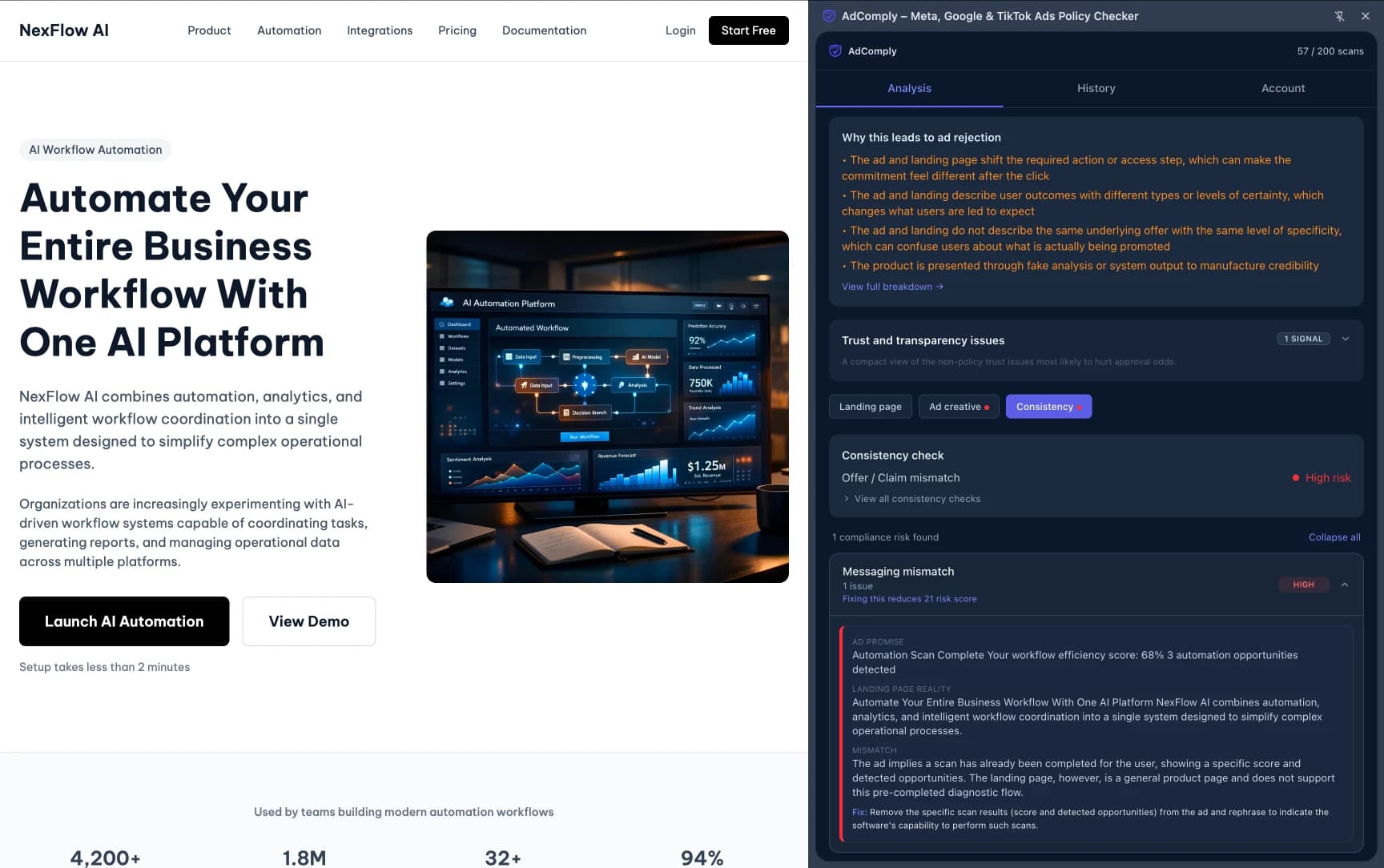
This is where many unstable funnels quietly break.
The ad creates one expectation.
The landing page intensifies it too aggressively.
That escalation changes how the experience gets classified.
Pages That Pass Review Usually Avoid Structural Pressure
This is another important pattern.
High-pressure structure tends to destabilize approvals.
Not because urgency itself is forbidden.
But because excessive escalation changes how intent gets interpreted.
I’ve seen landing pages become dramatically more stable after removing:
stacked countdown timers
constant CTA repetition
overlapping urgency banners
aggressive scarcity framing
The funnels still converted.
They just stopped feeling forceful.
That distinction matters more than people think.
Stable Funnels Usually Feel Predictable
This sounds simple, but it’s one of the clearest review signals.
Funnels that pass review consistently tend to feel structurally predictable.
The user understands:
where they are
what they’re interacting with
what happens after the click
I’ve had cases where review instability came from surprisingly small structural confusion:
unclear qualification flow
missing pricing context
sudden offer escalation
vague CTA wording
Individually, none looked catastrophic.
Together, they weakened predictability.
And once predictability drops, review systems become more cautious.
Trust Structure Quietly Affects Approval Stability
This part gets underestimated constantly.
Pages that pass review consistently usually feel complete.
Not perfect.
Complete.
There’s a difference.
I’ve seen structurally stable funnels consistently include:
clear branding
visible contact information
accessible legal pages
coherent page hierarchy
None of these automatically “approve” a page.
But together, they increase baseline trust.
And higher trust changes how the rest of the funnel gets interpreted.
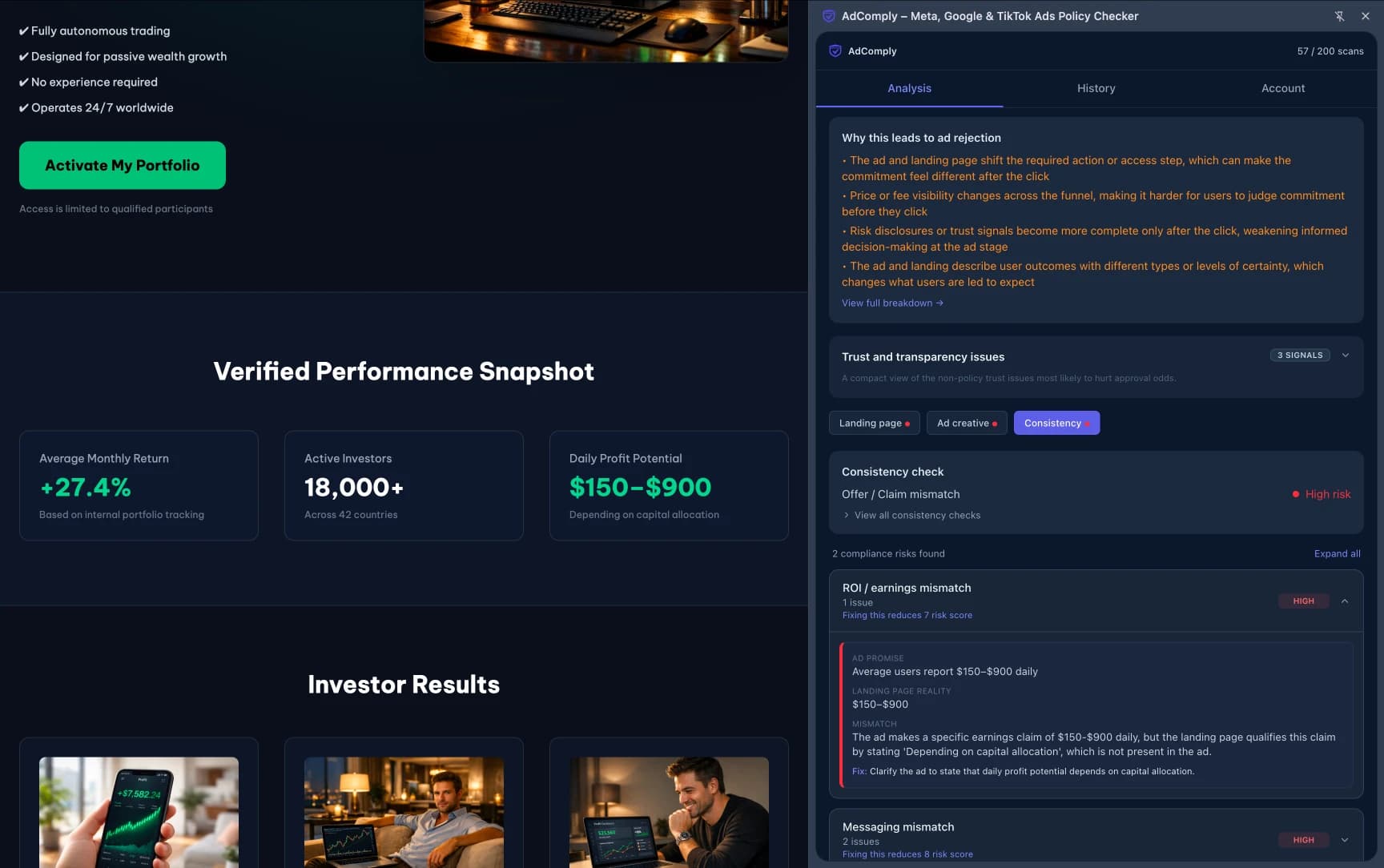
This becomes especially important in finance, health, employment, and other sensitive categories where platforms expect stronger structural reliability.
Landing Pages That Pass Review Usually Avoid Visual Overstatement
This is another consistent pattern.
Stable funnels rarely rely on exaggerated visual implication.
I’ve seen unstable pages overloaded with:
transformation imagery
extreme performance visuals
simulated dashboards
high-certainty outcome framing
Meanwhile, funnels that passed consistently usually felt more grounded visually.
The visuals supported the offer.
They didn’t aggressively amplify it.
That subtle distinction changes how the entire experience feels during review.
Pages That Pass Review Usually Maintain Clarity Across Funnel Steps
This becomes even more important in multi-step funnels.
Every additional click creates another place where consistency can break.
I’ve seen funnels where:
the ad stayed neutral
the bridge page became more emotional
the final landing page became highly outcome-focused
That gradual escalation destabilized approvals.
Not because any individual step violated policy.
Because the continuity weakened across the experience.
This type of structural drift appears frequently in ad-to-page mismatch analysis, where small expectation shifts accumulate across the funnel.
Funnels that pass review consistently usually avoid that escalation pattern.
The experience stays aligned from entry to conversion.
Review Stability Often Comes From Removing Friction, Not Removing Marketing
This is probably the most important shift.
Many advertisers think compliance means weakening the funnel.
In practice, stable funnels are often just clearer.
I’ve had campaigns where approval consistency improved after simplifying:
CTA hierarchy
headline transitions
qualification logic
visual intensity
The marketing stayed persuasive.
The experience simply became easier to interpret.
That’s a very different thing.
Why Some “Perfectly Fine” Pages Still Fail Review
This is the frustrating part.
You can follow visible policy guidance and still end up with unstable approvals.
Check Your Landing Page Before Running Ads
Analyze your landing page for risky claims, missing disclosures, trust gaps, and funnel issues before launching traffic.
No signup required • instant results • 5 free scans included
Because review systems are not checking isolated rules one by one.
They’re evaluating the overall behavioral pattern of the funnel.
I’ve seen pages that looked technically compliant still become unstable because:
clarity arrived too late
visual implication became too strong
the structure felt overly forceful
continuity weakened across funnel steps
None of those signals alone necessarily trigger rejection.
Together, they change how the page gets classified.
The Shift That Makes Approval Patterns Easier to Understand
At some point, the question changes.
Not “what wording is allowed?”
But “how does this entire experience feel structurally?”
That shift changes everything.
You stop thinking only about claims.
You start thinking about continuity, timing, pressure, predictability, and trust as one connected system.
If you want to see how stable and unstable structures compare in real campaigns, explore ad risk examples with detailed funnel breakdowns.
Because landing pages that pass Facebook review consistently are rarely “safe” by accident.
They usually reduce ambiguity before the system has a reason to distrust the funnel.