


Most people imagine Meta reviewing ads like a checklist.
This claim is fine. That one isn’t. This page passes. That one fails.
It’s a clean model. Logical. Easy to work with.
And it breaks almost immediately in real campaigns.
I’ve had funnels where the ad was compliant, the landing page was compliant, and still — something didn’t hold.
No obvious violation. No policy edge case.
Just instability. Rejections, limited delivery, inconsistent approvals.
That’s usually where the misunderstanding becomes obvious.
Meta doesn’t evaluate ads and landing pages separately. It reconstructs the relationship between them.
And that relationship is where mismatch becomes visible.
How Meta Evaluates Ads and Landing Pages as One System
The ad sets an expectation.
The landing page either confirms it — or subtly shifts it.
That transition is what Meta evaluates.
I’ve seen cases where both pieces were perfectly acceptable on their own, but the moment you moved from ad to page, the tone changed just enough to feel different.
Not wrong. Just inconsistent.
That’s the key distinction.
Meta is not validating individual elements.
It’s validating alignment across the sequence.
Meta Detects Mismatch Through Pattern Comparison
Meta doesn’t compare exact wording.
It compares patterns.
How strong is the promise?
How certain is the outcome?
How quickly does the page push action?
These are not read literally — they’re inferred.
I’ve had campaigns where the ad positioned the offer as something to explore, but the landing page immediately framed it as a direct result.
Same product. Same funnel.
Different pattern.
That’s enough to trigger a mismatch signal.
Because once the system detects two slightly different interpretations of intent, it has to resolve the inconsistency.
And unresolved inconsistency is treated as risk.
Where Meta Actually Looks for Mismatch
Mismatch rarely lives in a single sentence.
It usually appears across layers:
tone (informational vs outcome-driven)
structure (gradual vs immediate conversion)
timing (clarity before vs after interaction)
Each layer adds a small signal.
On its own, it might not matter.
Together, they define how the funnel is interpreted.
This is usually how it shows up in real campaigns:
Ad: “See if you qualify for this program” (conditional, screening-based framing)
Landing page: “Start using the system today” (direct access, reduced uncertainty)
Result: conditional → immediate access → intent shift → elevated risk
I’ve seen this pattern a lot in lead generation funnels. Nothing technically false, but the transition removes uncertainty instead of preserving it.
From the system’s perspective, that looks like expectation inflation.
Visual Signals Are Part of the Same Pattern
It’s not just about copy.
Meta evaluates visual context as well.
I’ve had ads with neutral presentation — simple layout, no implied outcomes — lead into landing pages filled with performance visuals, growth curves, or result-driven imagery.
No explicit claim.
But a very different signal.
That’s often enough to trigger reclassification.
Because the system doesn’t separate text and visuals.
It evaluates the combined pattern.
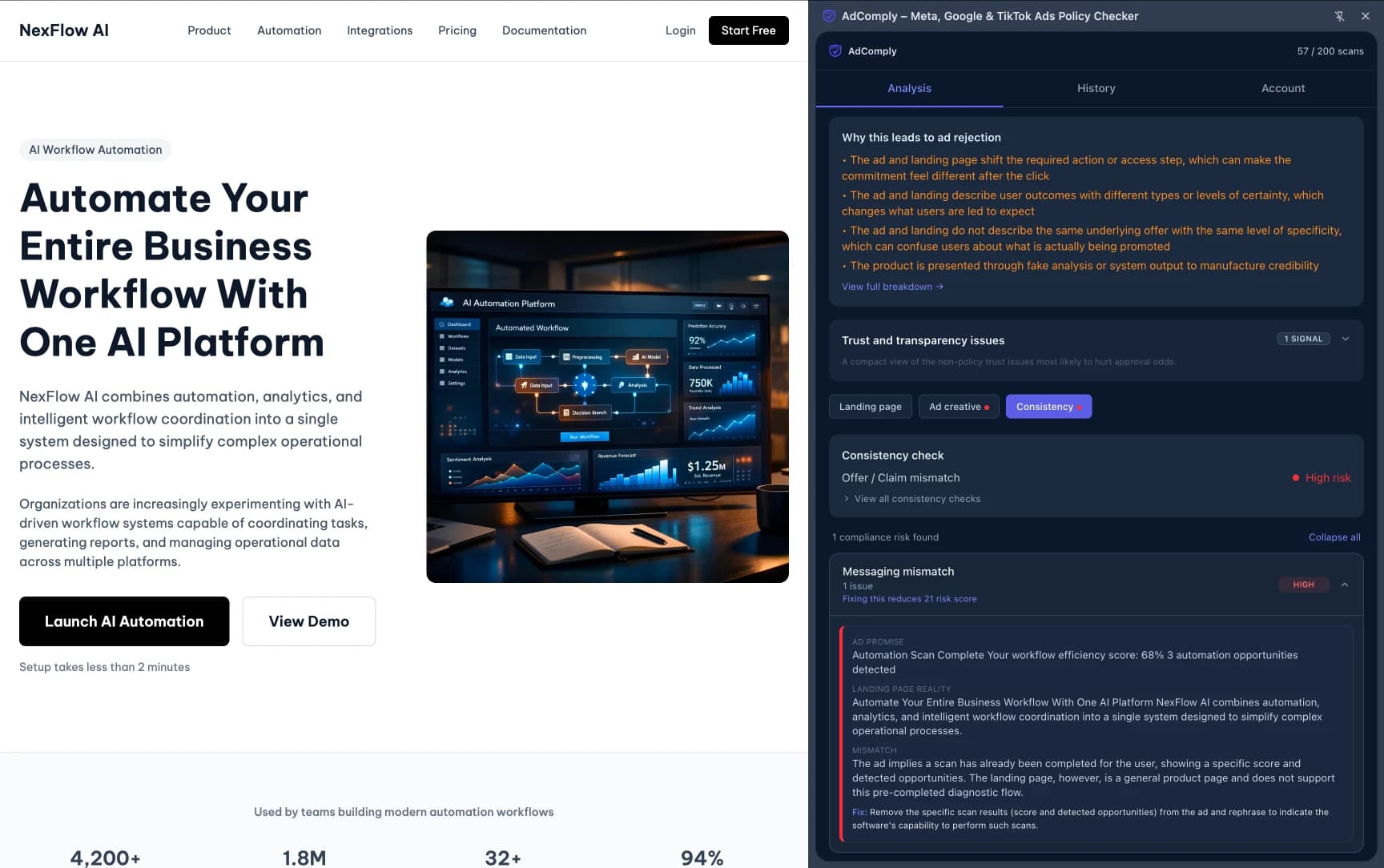
When you look at the funnel step by step, the shift becomes obvious. The ad introduces one interpretation, but the landing page reinforces another.
This type of inconsistency often appears in cases where ads follow policy but still get rejected, because the issue isn’t the rule — it’s the pattern.
Timing Differences Signal Intent Shifts
One of the less obvious signals Meta detects is timing.
Not just what is said, but when it appears.
I’ve seen funnels where the ad clearly explains the offer, but the landing page delays key details behind interaction — forms, steps, or gated sections.
From a user perspective, that’s a normal funnel.
From a system perspective, it looks like action is being pushed before clarity.
That changes how intent is interpreted.
And once intent becomes unclear, risk increases.
Mismatch Accumulates Across the Funnel
Meta doesn’t need a clear contradiction to flag a funnel.
Find Rejection Risks Before You Submit
Scan your ad funnel for policy risks, risky claims, landing-page issues, and ad-to-page mismatches before review.
No signup required • instant results • 5 free scans included
It only needs enough small inconsistencies.
I’ve seen funnels where:
the ad simplifies the offer
the landing page adds conditions
later steps introduce limitations
Each step is reasonable.
Together, they form a recognizable pattern.
And once that pattern becomes clear, the outcome is no longer unpredictable.
Why Fixing One Element Rarely Works
This is where most troubleshooting fails.
You adjust the ad.
Or you tweak the landing page.
And nothing changes.
Because mismatch is not located in a single element.
It exists in the relationship between them.
I’ve had cases where rewriting either side didn’t help — but aligning both together resolved the issue almost immediately.
That’s the difference between fixing content and fixing patterns.
If you want to see where these mismatches usually originate, explore specific landing page elements that trigger ad rejections.
Why Detection Gets Stronger Over Time
Another layer that often gets overlooked is accumulation.
A funnel might pass review at first.
Then start getting flagged later.
No changes.
It feels random.
But it isn’t.
As more data accumulates, the pattern becomes clearer.
Before you launch: A quick scan can show the issues that often lead to ad rejection before you send the campaign for review.
Scan your funnel now →And once the system is confident, enforcement becomes more consistent.
How to Think About Meta’s Detection System
At some point, the question changes.
Not “what rule did I break?”
But “where does the pattern shift?”
That shift is what makes Meta’s behavior predictable.
You stop analyzing pieces.
You start analyzing transitions.
If you want to see how these patterns look in real funnels, explore ad risk examples with detailed breakdowns.
Because Meta doesn’t flag ads randomly.
It detects alignment — or the lack of it.
And once the mismatch becomes visible, the outcome is no longer surprising.