


Health claims are one of the fastest ways to destabilize an advertising account.
Not necessarily because advertisers are intentionally deceptive.
But because health advertising sits inside one of the most sensitive trust categories platforms evaluate.
I’ve seen campaigns get rejected even when the wording looked relatively moderate.
No miracle cures. No impossible guarantees. No obviously fabricated science.
And still, approval stability kept collapsing.
That’s usually when advertisers realize something important:
Health claim enforcement is not only about medical accuracy — it’s about expectation control, emotional sensitivity, and perceived user safety.
The system is constantly asking:
“Could this experience realistically influence vulnerable decision-making?”
Health Claims Are Evaluated Through Risk Amplification
This is the first major shift most advertisers underestimate.
Platforms do not evaluate health advertising like normal consumer marketing.
They evaluate it through amplified caution.
I’ve seen relatively soft health messaging become unstable because the surrounding structure intensified:
certainty
urgency
transformation expectation
emotional vulnerability
The wording itself sometimes looked technically careful.
The broader experience still created high-risk interpretation signals.
That’s why many advertisers feel confused after repeated health-related disapprovals.
The issue often exists in implication patterns rather than one obvious sentence.
Platforms React Aggressively To Implied Medical Certainty
This becomes especially visible in supplement, wellness, and fitness advertising.
I’ve seen ads become unstable because the messaging subtly implied:
guaranteed improvement
predictable physical transformation
rapid recovery
automatic biological outcomes
Even when the advertiser never explicitly promised those results.
The combination of visuals, sequencing, and emotional framing still implied certainty.
That’s where many health-claim violations actually originate.
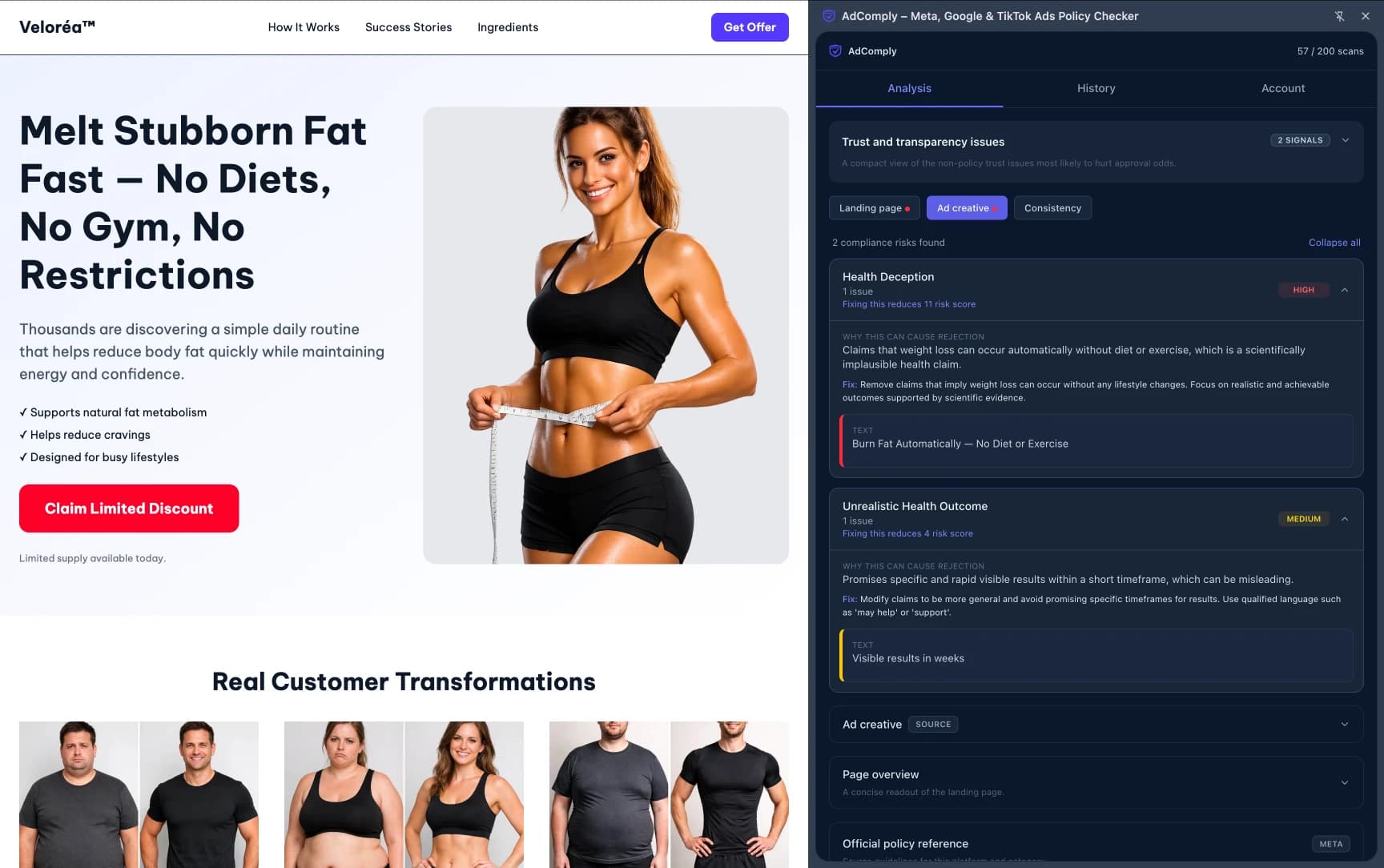
I’ve had campaigns stabilize simply by reducing the emotional certainty surrounding the outcome rather than rewriting the entire offer.
The system reacted differently because the implied guarantee weakened.
Transformation Narratives Create Elevated Risk
This is one of the biggest structural triggers inside health advertising.
The more clearly the ad communicates:
“You are here now, but you could become this version of yourself quickly.”
the more aggressively the system tends to evaluate the experience.
I’ve reviewed funnels where the instability came less from the product itself and more from the emotional progression structure:
before-and-after comparison sequences
dramatic body transformation imagery
emotionally loaded testimonials
fast-outcome framing
At some point, the funnel stops feeling informational.
It starts feeling psychologically coercive.
That’s usually where policy instability accelerates.
Scientific Language Does Not Automatically Reduce Risk
This surprises advertisers constantly.
Many assume that adding scientific terminology makes claims safer.
Sometimes it helps.
Sometimes it makes the review stricter.
I’ve seen unstable campaigns rely heavily on:
pseudo-medical terminology
selective scientific references
lab-style visual aesthetics
overly technical authority framing
The issue was not necessarily factual inaccuracy.
The issue was that the structure exaggerated perceived medical legitimacy.
Platforms evaluate whether scientific framing is being used to amplify trust beyond what the offer realistically supports.
Health Advertising Is Highly Sensitive To Emotional Vulnerability
This is another major layer.
I’ve seen ads become unstable because they emotionally targeted:
body insecurity
fear of aging
medical anxiety
low self-esteem
Even when the advertiser technically avoided explicit Personal Attributes language.
The emotional architecture still made the experience feel psychologically invasive.
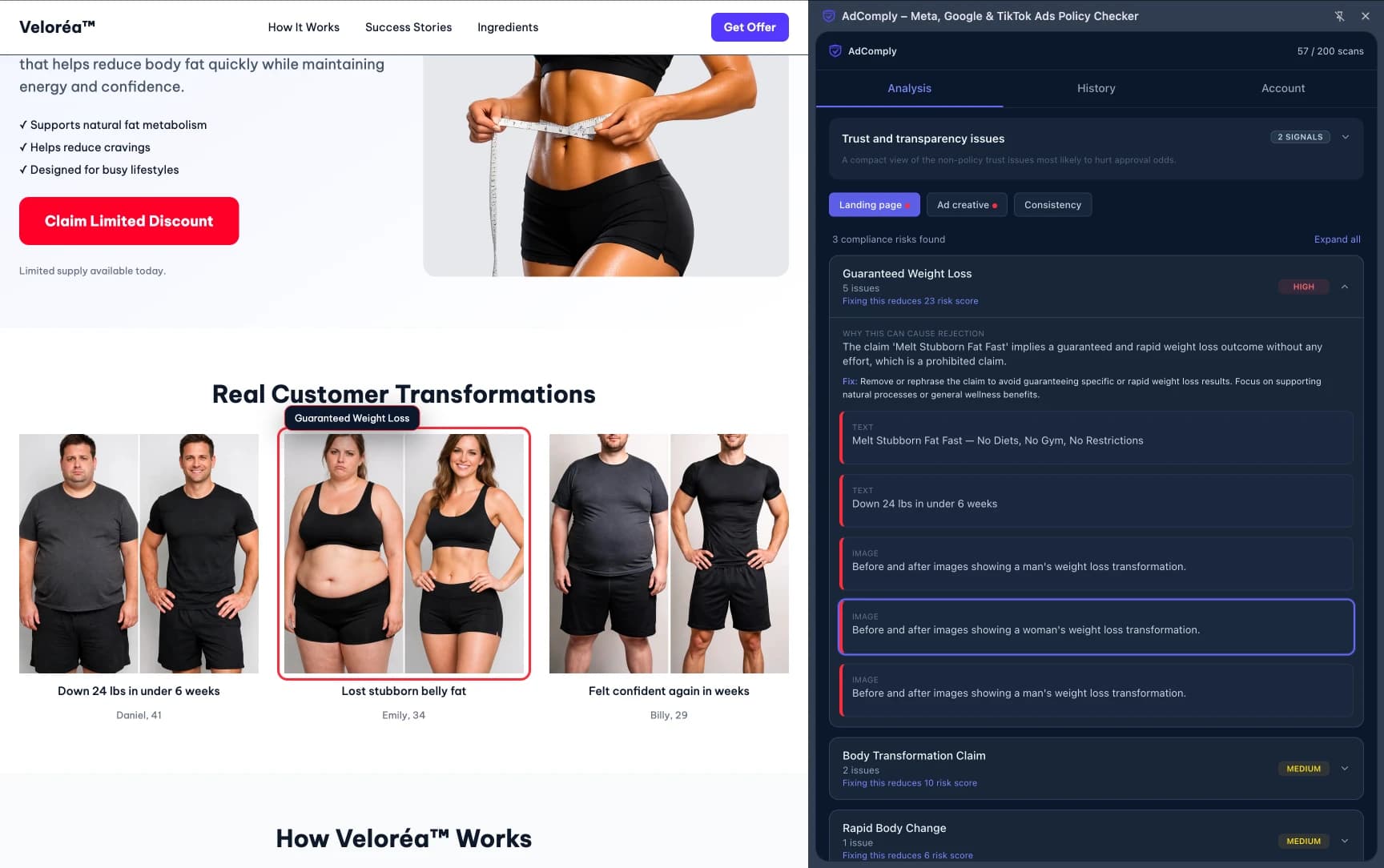
I’ve seen approval stability improve simply by reducing emotional pressure and making the experience feel more educational than corrective.
The offer stayed identical.
The perceived vulnerability targeting changed.
Funnels Often Escalate Health Claims Gradually
This is where many advertisers accidentally increase risk without noticing it.
The ad begins relatively soft.
The funnel intensifies certainty deeper into the experience.
I’ve reviewed structures where:
the ad suggested possibility
the bridge page introduced stronger transformation stories
the landing page implied near-certain outcomes
No individual stage looked catastrophic in isolation.
Together, the funnel gradually amplified expectation pressure.
That progression often creates more instability than one aggressive headline.
This type of escalation structure also appears inside before-and-after advertising analysis, where emotional certainty increases gradually across the funnel.
Historical Trust Signals Influence Health Claim Interpretation
This is another reason health advertising often feels unpredictable.
The same wording can behave very differently depending on the surrounding trust environment.
I’ve seen advertisers clean up copy significantly while leaving the same emotional transformation structure underneath.
Find Rejection Risks Before You Submit
Scan your ad funnel for policy risks, risky claims, landing-page issues, and ad-to-page mismatches before review.
No signup required • instant results • 5 free scans included
The instability remained.
Because the system was still interpreting the overall experience as high-risk.
At that point, superficial wording edits rarely solve the problem.
You’re not just adjusting claims.
You’re trying to reduce perceived medical certainty and emotional leverage throughout the full experience.
Health Claim Policies Are Ultimately About User Protection
This is probably the clearest way to understand the system.
Platforms do not want health advertising experiences that make vulnerable users feel:
guaranteed recovery
certain transformation
urgent fear-based pressure
emotionally manipulated into action
The more aggressively a funnel pushes those emotional states, the more carefully the system tends to evaluate it.
I’ve seen advertisers accidentally destabilize campaigns simply by trying to make the transformation “feel more motivating.”
At some point, motivation starts becoming medical pressure.
That’s where the review profile changes.
The Shift That Makes Health Claim Policies Easier To Understand
At some point, the question changes.
Not:
“Is this health claim technically allowed?”
But:
“What emotional certainty and medical expectation does this experience create?”
That shift changes how you analyze health advertising completely.
You stop focusing only on restricted wording.
You start analyzing implication, vulnerability, emotional pressure, transformation framing, and expectation escalation together.
Before you launch: A quick scan can show the issues that often lead to ad rejection before you send the campaign for review.
Scan your funnel now →Many of these medical-risk patterns also overlap with Personal Attributes enforcement, where emotional sensitivity and identity-based vulnerability become part of the review process.
Because health claim enforcement is rarely about one sentence alone.
It usually happens when the overall advertising experience starts creating more certainty, urgency, or emotional pressure than the platform is willing to trust safely.