


Before-and-after advertising looks simple on the surface.
Show a transformation. Demonstrate results. Make the outcome visually obvious.
That’s exactly why advertisers keep running into problems with it.
I’ve seen campaigns get flagged even when the advertiser technically avoided explicit promises.
No guaranteed outcomes. No fabricated wording. No direct claim that “everyone will achieve this result.”
And still, approvals became unstable almost immediately.
That’s because platforms rarely evaluate before-and-after content as isolated images.
They evaluate it as a psychological expectation mechanism.
The system is not only asking whether the transformation is real.
It’s asking what the transformation structure implies to the average user.
Before-and-After Ads Create Implied Guarantees
This is the core issue most advertisers underestimate.
Even without explicit wording, before-and-after framing naturally suggests:
predictable transformation
repeatable outcomes
high probability of success
clear emotional progression
The visual sequence itself creates expectation pressure.
I’ve seen advertisers carefully soften the copy while leaving the transformation framing untouched.
The system still reacted aggressively.
Because the implication was already embedded structurally inside the visual narrative.
Platforms Evaluate Emotional Manipulation Risk
This is where before-and-after rules become more psychological than technical.
The issue is not only whether the transformation is accurate.
It’s whether the ad is emotionally exploiting insecurity or vulnerability.
I’ve reviewed campaigns where the transformation sequence intensified:
body insecurity
social comparison pressure
financial desperation
self-worth anxiety
Even when the advertiser never stated those emotions directly.
The transformation framing still reinforced them visually.
That’s why before-and-after enforcement often overlaps with Personal Attributes and misleading-claims policies at the same time.
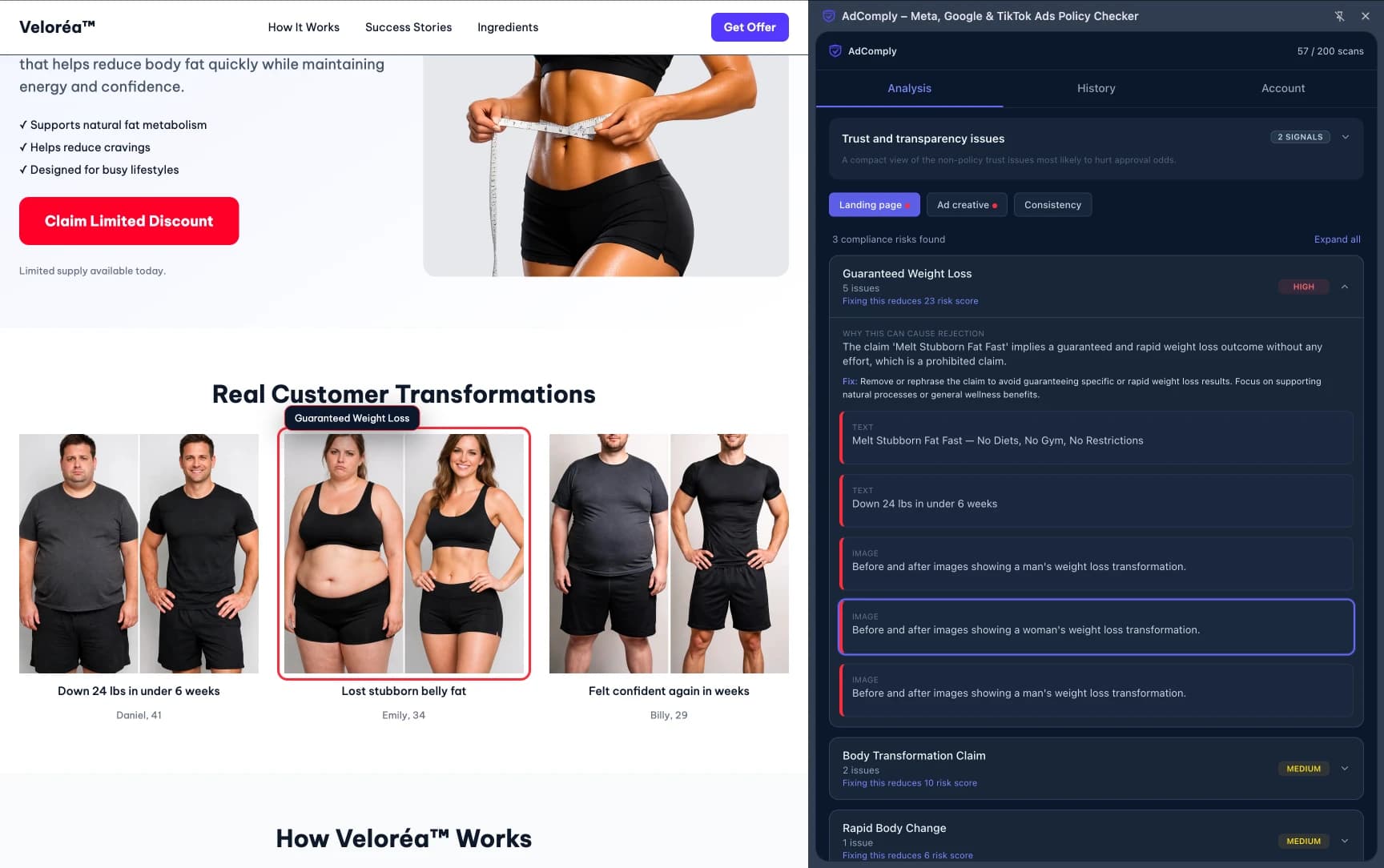
I’ve had campaigns stabilize simply by removing transformation sequencing while keeping the same product and offer structure.
The emotional pressure dropped immediately.
Visual Transformation Often Matters More Than The Copy
This surprises advertisers constantly.
They focus entirely on wording compliance while the imagery itself becomes the primary risk signal.
I’ve seen ads become unstable because of:
extreme physical contrast
dramatic body reshaping
emotionally loaded comparison framing
visual implication of guaranteed progression
Sometimes the text itself looked relatively harmless.
The visual story still implied certainty.
That distinction matters heavily inside modern review systems.
Transformation Sequences Create Predictive Narratives
This is another reason platforms evaluate before-and-after structures aggressively.
The sequence naturally tells the user:
“This is what happens if you follow this process.”
That implication becomes especially dangerous in categories involving:
weight loss
fitness
cosmetic appearance
financial success
medical outcomes
I’ve seen funnels destabilize not because the results were fake, but because the narrative certainty became too strong.
The more linear and emotionally satisfying the progression feels, the more carefully platforms tend to evaluate it.
“Real Results” Language Does Not Automatically Reduce Risk
This is another common misconception.
Advertisers often assume disclaimers solve the problem:
“Results may vary”
“Real customer story”
“Individual outcomes differ”
Sometimes they help.
But I’ve seen many cases where the transformation framing itself still overwhelmed the disclaimer.
The emotional implication remained stronger than the qualification language.
That’s why platforms evaluate the overall expectation pattern — not just isolated legal wording.

I’ve had advertisers reduce rejection frequency simply by showing process-oriented visuals instead of dramatic outcome contrast.
The perceived certainty changed even though the product remained identical.
Funnels Often Intensify Transformation Pressure After The Click
This is where things become harder to diagnose.
The ad starts relatively moderate.
The landing page amplifies the transformation narrative aggressively.
I’ve reviewed funnels where:
the ad introduced possibility
the bridge page introduced emotional storytelling
the landing page implied inevitable transformation
No single stage looked catastrophic alone.
Together, the funnel gradually escalated certainty and emotional pressure.
That progression often creates more instability than one aggressive headline.
This escalation pattern also appears inside misleading claims analysis, where expectation intensity increases gradually across the advertising flow.
Before-and-After Rules Are Ultimately About Expectation Control
This is probably the clearest way to understand the policy.
Check Your Landing Page Before Running Ads
Analyze your landing page for risky claims, missing disclosures, trust gaps, and funnel issues before launching traffic.
No signup required • instant results • 5 free scans included
Platforms do not want advertising experiences that make transformation feel guaranteed, universal, or psychologically coercive.
The more the experience feels like:
inevitable success
automatic progression
emotionally manipulative comparison
identity-based insecurity pressure
the more aggressively review systems tend to react.
I’ve seen advertisers accidentally trigger instability simply by making transformation visuals “more motivating.”
At some point, motivation starts becoming emotional exploitation.
That’s where the risk profile changes.
Historical Trust Signals Influence Transformation Interpretation
This is another reason before-and-after policies often feel inconsistent.
The same transformation structure can behave differently depending on the broader trust environment around it.
I’ve seen advertisers clean up wording substantially while keeping the same aggressive visual progression underneath.
The instability remained.
Because the system was still interpreting the overall expectation structure as high-risk.
At that point, superficial edits rarely solve the issue.
You’re not just changing images.
You’re trying to reduce the emotional certainty embedded throughout the experience.
The Shift That Makes Before-and-After Rules Easier To Understand
At some point, the question changes.
Not:
“Are before-and-after images technically allowed?”
But:
“What expectation and emotional pressure does this transformation narrative create?”
That shift changes how you analyze advertising completely.
Before you launch: Landing-page issues are hard to catch manually because the problem is often the combination of copy, claims, trust signals, and ad consistency.
Scan your funnel now →You stop thinking only about visual compliance.
You start thinking about implication, emotional leverage, certainty, comparison pressure, and psychological framing together.
Many of these transformation-risk patterns also appear inside Personal Attributes policy analysis, where emotional vulnerability and identity-based targeting overlap with visual expectation systems.
Because before-and-after enforcement is rarely about one image alone.
It usually happens when the full advertising experience starts making transformation feel more certain, universal, or emotionally loaded than the platform is willing to trust.