


Most advertisers think policy compliance is evaluated at the ad level.
The headline gets reviewed. The image gets scanned. The copy gets classified.
That’s part of the process.
But it’s not the whole system.
I’ve had funnels where the ad itself looked extremely conservative — soft wording, neutral visuals, almost painfully careful positioning.
And still, approvals stayed unstable.
The reason only became obvious after mapping the full funnel from click to conversion.
Because ad platforms rarely evaluate isolated components anymore.
They evaluate behavioral continuity across the entire experience.
Funnels create policy risk when structure, timing, and messaging evolve in ways the system no longer fully trusts.
Funnels Are Evaluated As Connected Systems
This is the first thing most advertisers underestimate.
The ad is not treated as a standalone object.
It becomes the entry point into a larger behavioral sequence.
That means every step after the click matters:
bridge pages
lead forms
qualification flows
multi-step landing pages
checkout transitions
I’ve seen perfectly compliant ads lead into unstable funnels simply because the experience gradually shifted tone after the click.
The ad created one expectation.
The funnel slowly created another.
That’s where policy interpretation usually starts changing.
Funnels Often Escalate Faster Than Advertisers Realize
This happens constantly in performance marketing.
The first step stays soft.
The next step becomes more persuasive.
The final step becomes highly conversion-focused.
Individually, none of the pages may look extreme.
Together, the funnel creates directional escalation.
I’ve reviewed funnels where the ad felt educational, the bridge page became emotionally suggestive, and the final landing page implied certainty.
No single component looked catastrophic.
The progression itself created the problem.
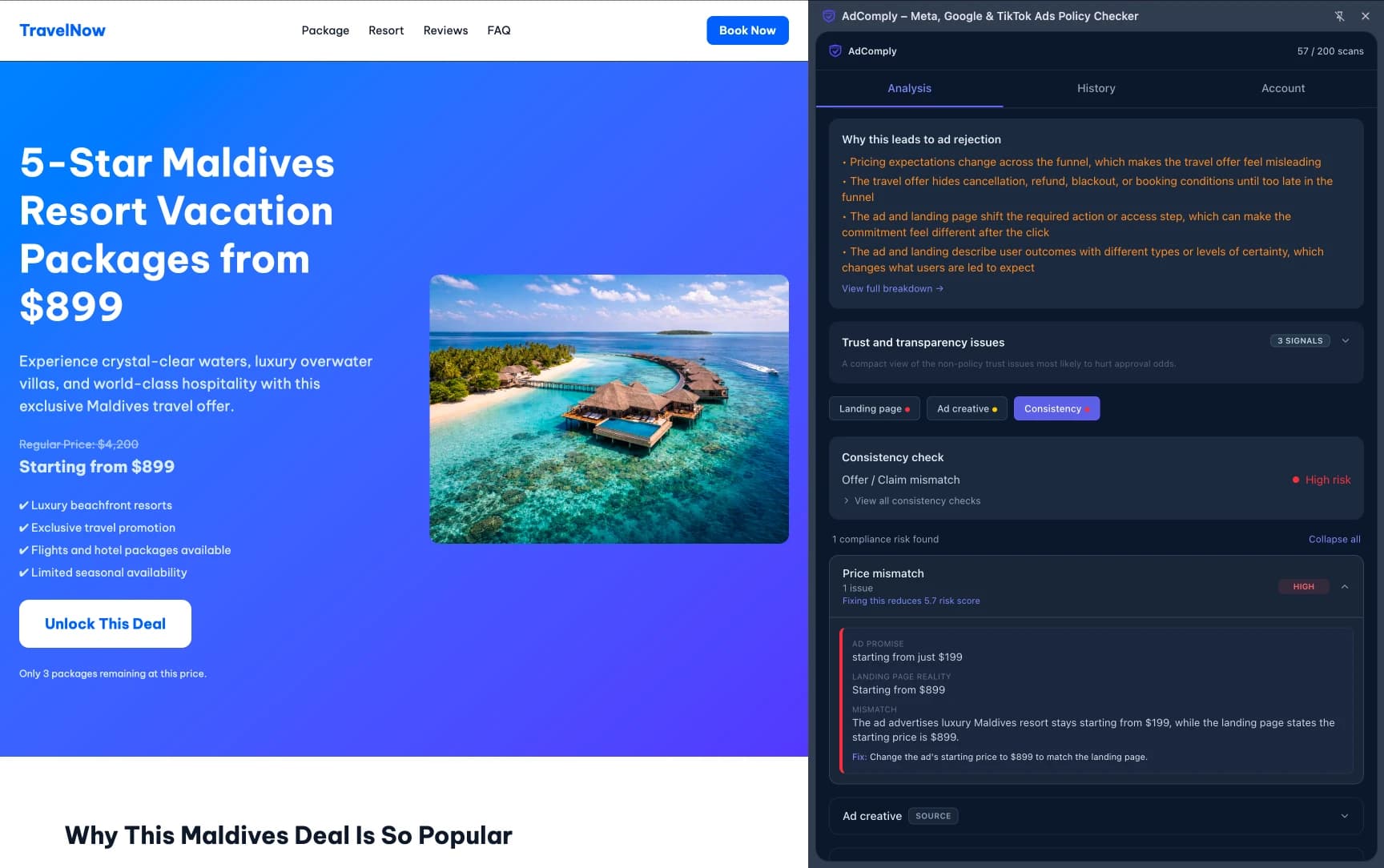
This is one of the reasons policy issues inside funnels often feel confusing.
The instability usually comes from accumulation, not one obvious violation.
Policy Systems Compare Expectation Continuity
This is where consistency becomes critical.
The system is constantly comparing:
what the ad implied
what the next page suggests
how the offer evolves later
Even small shifts matter.
I’ve had campaigns where approval stability improved after aligning something as simple as CTA phrasing between the ad and landing page.
Same offer.
Same conversion flow.
Different continuity.
That’s an important distinction.
The system often evaluates the gap between stages more aggressively than the stages themselves.
This continuity analysis appears constantly in ad review system comparisons, where small expectation gaps compound across the funnel.
Funnels Frequently Delay Critical Information
This is another major policy trigger.
Many funnels prioritize momentum before clarity.
The user is encouraged to click, continue, qualify, or engage before fully understanding the offer.
I’ve seen funnels where:
pricing appeared late
eligibility conditions appeared after interaction
limitations were buried deeper in the flow
core explanations arrived near conversion
From a marketing perspective, this structure can perform well.
From a compliance perspective, it often looks like staged disclosure.
And staged disclosure increases perceived risk.

I’ve tested this directly in several campaigns.
Moving key explanatory content earlier improved approval stability without reducing conversion performance.
The funnel simply became easier for the system to interpret.
Funnels Also Amplify Pressure Signals
This is where optimization tactics start colliding with review systems.
Funnels naturally encourage pressure escalation near conversion:
stronger urgency
scarcity reinforcement
repeated CTA stacking
heavier emotional framing
The issue is not urgency alone.
The issue is cumulative force.
I’ve also seen funnels destabilize approvals because the UX itself became too aggressive.
Things like:
blocking exit behavior
stacked pop-ups interrupting navigation
constant modal interruptions
forcing interaction before returning to content
From a conversion perspective, these tactics are often meant to keep momentum high.
From a behavioral analysis perspective, they can look like attempts to override user intent.
That’s where the funnel stops feeling persuasive and starts feeling coercive.
I’ve had funnels where removing one aggressive urgency section improved approval stability almost immediately.
The funnel still converted.
It just stopped feeling structurally coercive.
That difference matters more than most advertisers expect.
Bridge Pages Create Additional Compliance Fragility
Bridge pages deserve separate attention because they introduce another interpretation layer between the ad and final offer.
Every additional transition creates another place where:
messaging can drift
tone can intensify
trust can weaken
clarity can fragment
I’ve seen funnels where the ad and final page were aligned reasonably well — but the bridge page destabilized the entire experience.
Not through explicit violations.
Through subtle structural shifts.
That’s why bridge pages often become invisible sources of review instability.
Compliance Problems Usually Build Gradually
This is another important shift.
Most funnel-related policy issues don’t come from one catastrophic mistake.
They emerge gradually as smaller signals accumulate:
slightly delayed clarity
slightly stronger promises
slightly weaker trust structure
slightly more aggressive progression
Eventually the funnel crosses a structural threshold.
That’s when approvals become unstable.
I’ve seen advertisers spend weeks rewriting ads when the real issue was the overall behavioral flow underneath them.
Funnels Affect Performance Stability Too
This part gets overlooked constantly.
Compliance instability doesn’t just create rejection problems.
It can quietly affect delivery and performance as well.
Find Rejection Risks Before You Submit
Scan your ad funnel for policy risks, risky claims, landing-page issues, and ad-to-page mismatches before review.
No signup required • instant results • 5 free scans included
I’ve seen unstable funnels correlate with:
higher CPC volatility
more manual reviews
delivery inconsistency
sudden approval swings
Because review systems and performance systems are not completely isolated.
Both are trying to evaluate trust and reliability signals.
Why Funnel-Based Rejections Often Feel Random
This is the frustrating part.
You review the landing page.
The ad looks fine.
The bridge page seems harmless.
And still, approvals collapse unpredictably.
That usually happens because the instability exists in the interaction between stages.
Not inside one isolated component.
I’ve had funnels where the issue only became obvious after mapping every transition visually from first impression to final conversion step.
That’s when the continuity drift finally became visible.
The Shift That Makes Funnel Compliance Easier to Understand
At some point, the question changes.
Not “which page violates policy?”
But “how does this funnel evolve behaviorally after the click?”
That shift changes how you analyze advertising systems.
You stop auditing pages individually.
You start auditing transitions, escalation, pressure, continuity, and timing across the full experience.
Many of these escalation and continuity problems also appear inside Facebook funnel review instability patterns, where structural drift accumulates across multiple stages.
Because most funnel-related policy problems are not caused by one obvious violation.
They happen when the system gradually loses confidence in the overall direction of the experience.