


Most advertisers blame the ad when Facebook rejects a campaign.
The copy gets rewritten. The headline gets softened. The CTA changes.
Meanwhile, the actual issue often sits deeper in the funnel.
I’ve had campaigns where the ad itself looked completely harmless — neutral wording, clean visuals, conservative framing.
And still, approvals kept collapsing.
The reason became obvious only after reviewing the full flow step by step.
Because Facebook rarely evaluates the ad in isolation.
It evaluates the experience the ad leads into.
And funnels are where interpretation starts becoming unstable.
The more steps a funnel has, the more opportunities there are for clarity, consistency, and trust to drift apart.
Funnels Create Structural Escalation
This is one of the biggest reasons funnels become risky.
The experience gradually intensifies after the click.
The ad starts neutral.
The bridge page becomes more persuasive.
The final landing page becomes highly outcome-focused.
Individually, each step may seem acceptable.
Together, they create escalation.
I’ve seen funnels where no single page looked problematic on its own — but the progression across the funnel changed how the system interpreted intent.
That’s the important distinction.
Facebook often reacts to directional movement, not isolated elements.
Bridge Pages Frequently Introduce Interpretation Gaps
This becomes especially common with pre-landers and bridge pages.
Advertisers use them to warm traffic, improve conversion rates, or soften direct-response messaging.
From a marketing perspective, that makes sense.
From a review perspective, every additional layer creates another point where consistency can break.
I’ve seen funnels where:
the ad sounded informational
the bridge page became emotionally persuasive
the final page introduced stronger promises
Nothing explicitly violated policy.
But the continuity weakened at every transition.
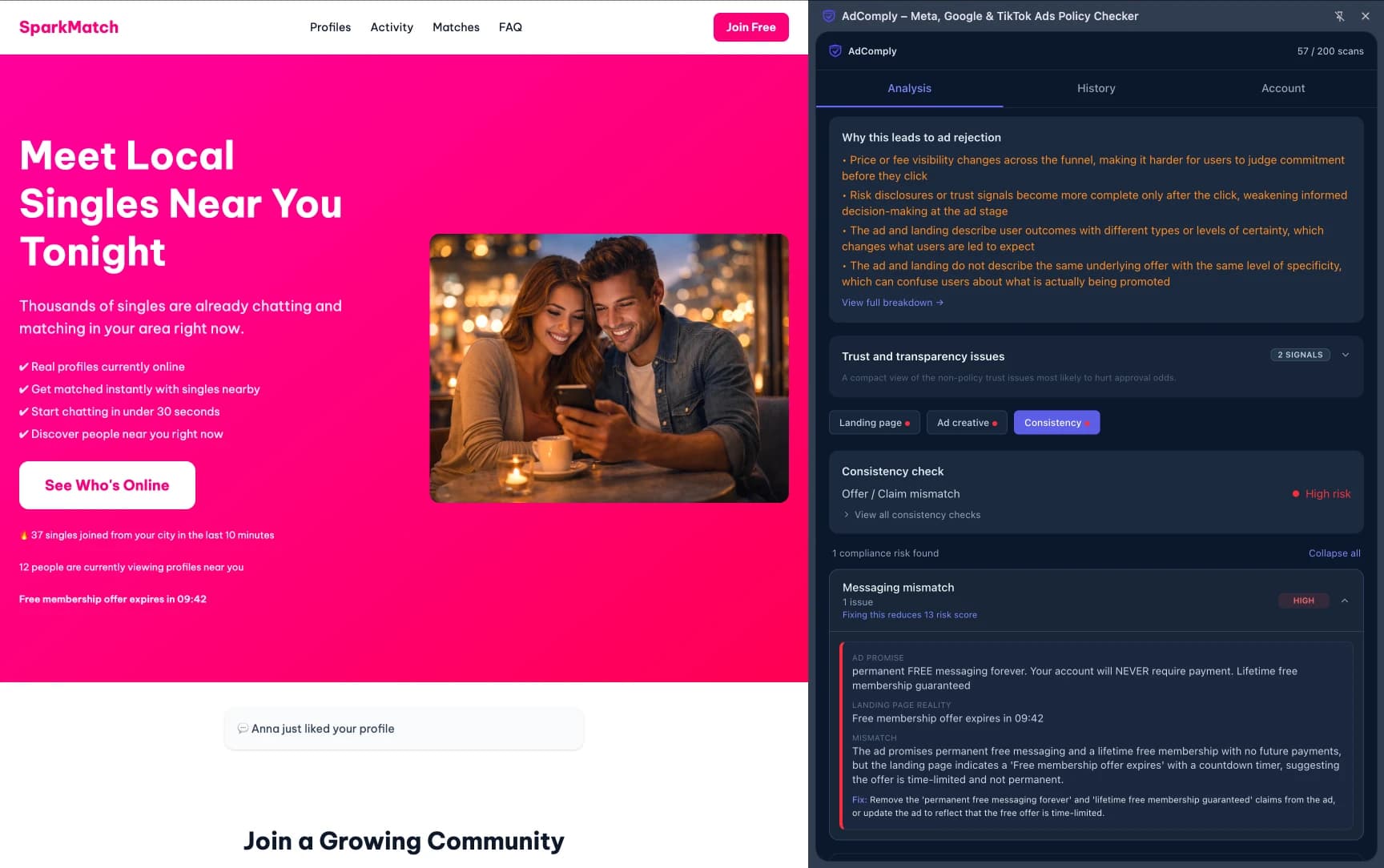
That’s usually where funnels become unstable.
Not because the system sees one dangerous page.
Because it sees a changing pattern of intent.
Funnels Often Delay Clarity Too Long
This is another major issue.
Many funnels prioritize curiosity and momentum before explanation.
The user clicks first.
The actual context appears later.
I’ve seen funnels where:
pricing appeared only after interaction
eligibility conditions appeared several steps later
the real offer became fully visible only near conversion
From a conversion perspective, these structures can work extremely well.
From a review perspective, they often look like staged disclosure.
And staged disclosure increases perceived risk.

I’ve tested this directly in several funnels.
Moving explanatory sections earlier consistently improved approval stability without changing the offer itself.
The experience simply became easier to interpret earlier in the journey.
Funnels Make Messaging Drift Harder to Control
This is one of the more subtle problems.
Every page in the funnel slightly reframes the offer.
And over time, those small shifts accumulate.
I’ve seen funnels where the ad implied exploration, but by the final page the tone became aggressively outcome-driven.
The advertiser didn’t intentionally create inconsistency.
The funnel evolved that way step by step.
That’s why funnel-based review issues are often difficult to diagnose.
The problem is usually not obvious on a single page.
Check Your Landing Page Before Running Ads
Analyze your landing page for risky claims, missing disclosures, trust gaps, and funnel issues before launching traffic.
No signup required • instant results • 5 free scans included
It becomes visible only when you compare the entire sequence together.
This type of continuity drift appears constantly in ad-to-page consistency analysis, where small framing shifts compound across multiple funnel stages.
Funnels Often Amplify Pressure Signals
This is where conversion optimization starts conflicting with review stability.
Funnels naturally encourage escalation:
stronger CTAs
heavier urgency
more emotional framing
higher pressure near conversion
That progression is normal in direct-response marketing.
But excessive pressure changes how the funnel gets classified.
I’ve had campaigns where removing one aggressive urgency section improved approvals without hurting conversion rates.
That’s usually a sign the funnel crossed a structural threshold.
Funnels Are Evaluated Behaviorally, Not Just Visually
This is another thing advertisers underestimate.
Facebook does not just evaluate static content.
It evaluates flow behavior.
How the experience unfolds matters.
I’ve seen funnels where:
pop-ups appeared later
additional claims loaded dynamically
pressure increased after user interaction
The static landing page looked safe.
The behavioral flow didn’t.
That’s why some funnels feel “mysteriously” unstable even when the visible content looks compliant.
The review system is often reacting to progression patterns, not isolated screenshots.
Funnels Also Carry Historical Risk
This is where things become frustrating.
Before you launch: Landing-page issues are hard to catch manually because the problem is often the combination of copy, claims, trust signals, and ad consistency.
Scan your funnel now →Funnels accumulate signals over time.
I’ve seen cleaned-up funnels continue experiencing instability because the historical pattern was already associated with higher risk.
At that point, you’re not just fixing pages.
You’re trying to shift a learned behavioral profile.
And that takes time.
Especially in niches where Facebook already expects elevated review sensitivity.
Why Simple Landing Pages Sometimes Perform Better Long-Term
This doesn’t mean funnels are inherently bad.
Some complex funnels pass review consistently.
But structurally simpler experiences are usually easier for the system to classify confidently.
Less ambiguity.
Less escalation.
Less continuity drift.
I’ve seen advertisers improve long-term delivery stability simply by removing unnecessary transitions between the ad and the final offer.
Not because shorter funnels magically convert better.
Because cleaner interpretation reduces review friction.
The Shift That Makes Funnel Rejections Easier to Understand
At some point, the question changes.
Not “which page is causing the rejection?”
But “how does the entire funnel evolve structurally after the click?”
That shift changes how you analyze advertising systems.
You stop reviewing pages individually.
You start reviewing continuity, escalation, timing, pressure, and expectation flow across the full journey.
Many of these escalation patterns also appear inside high-risk landing page structures, where smaller instability signals gradually compound across the experience.
Because Facebook rarely rejects funnels because of one catastrophic mistake.
Most of the time, the funnel simply evolves into something the system no longer fully trusts.