


Most advertisers don’t think of “promises” as a technical risk.
It feels like a copywriting concern. Tone, persuasion, positioning.
Something you tweak for performance, not compliance.
Until the ads start getting rejected.
Or they pass — but performance becomes unstable, inconsistent, expensive.
I’ve had funnels where nothing looked wrong in isolation. The ad made sense. The landing page made sense.
But the promise didn’t land the same way in both places.
That’s where things started breaking.
Because platforms don’t evaluate what you say.
They evaluate whether the same thing is being said across the entire flow.
Why Ad Promises Are Treated as Expectations
An ad doesn’t just communicate an offer.
It sets an expectation.
What the user will see. What they will get. What will happen next.
The landing page is supposed to confirm that expectation.
Not reinterpret it.
I’ve seen ads framed as “see how this works” lead into pages that immediately push results.
Nothing false.
But the expectation changes.
And that’s where the system starts flagging risk.
Mismatch Happens Even When Both Sides Are “Correct”
This is where most confusion comes from.
You can have:
a compliant ad
a compliant landing page
And still get rejected.
I’ve had campaigns where both sides passed policy review individually.
But together, they created a gap.
Not a violation.
A mismatch.
That gap forces interpretation.
And interpretation is what increases risk.
Where Ad Promises Usually Break
The break rarely looks dramatic.
It shows up in small shifts:
ad suggests possibility → page implies certainty
ad frames exploration → page pushes action
ad simplifies → page complicates
Each step makes sense on its own.
Together, they change the meaning of the promise.
This is usually how it shows up in practice:
Ad: “See how people are improving their workflow” (observational, indirect)
Landing page: “Transform your workflow starting today” (direct, outcome-driven)
Result: observation → transformation → promise escalation
I’ve seen this exact shift cause rejections even when both sides looked “safe”.
Because the promise didn’t stay consistent.
Why Escalation Is Treated as Risk
From a human perspective, escalation feels normal.
You introduce softly, then strengthen the message.
That’s basic marketing.
From a system perspective, it looks different.
I’ve had funnels where the ad was intentionally neutral, but the landing page amplified the message.
The system interpreted that as two different versions of the same offer.
And when it sees two versions, it has to decide which one represents the actual intent.
That uncertainty is what triggers flags.
Visual Promises Matter Too
Not all promises are written.
Some are implied.
I’ve had cases where the ad copy was perfectly aligned with the landing page — but the visuals weren’t.
The ad stayed neutral.
The landing page showed outcomes.
Dashboards. Transformations. Results.
No explicit claim.
But a clear implication.
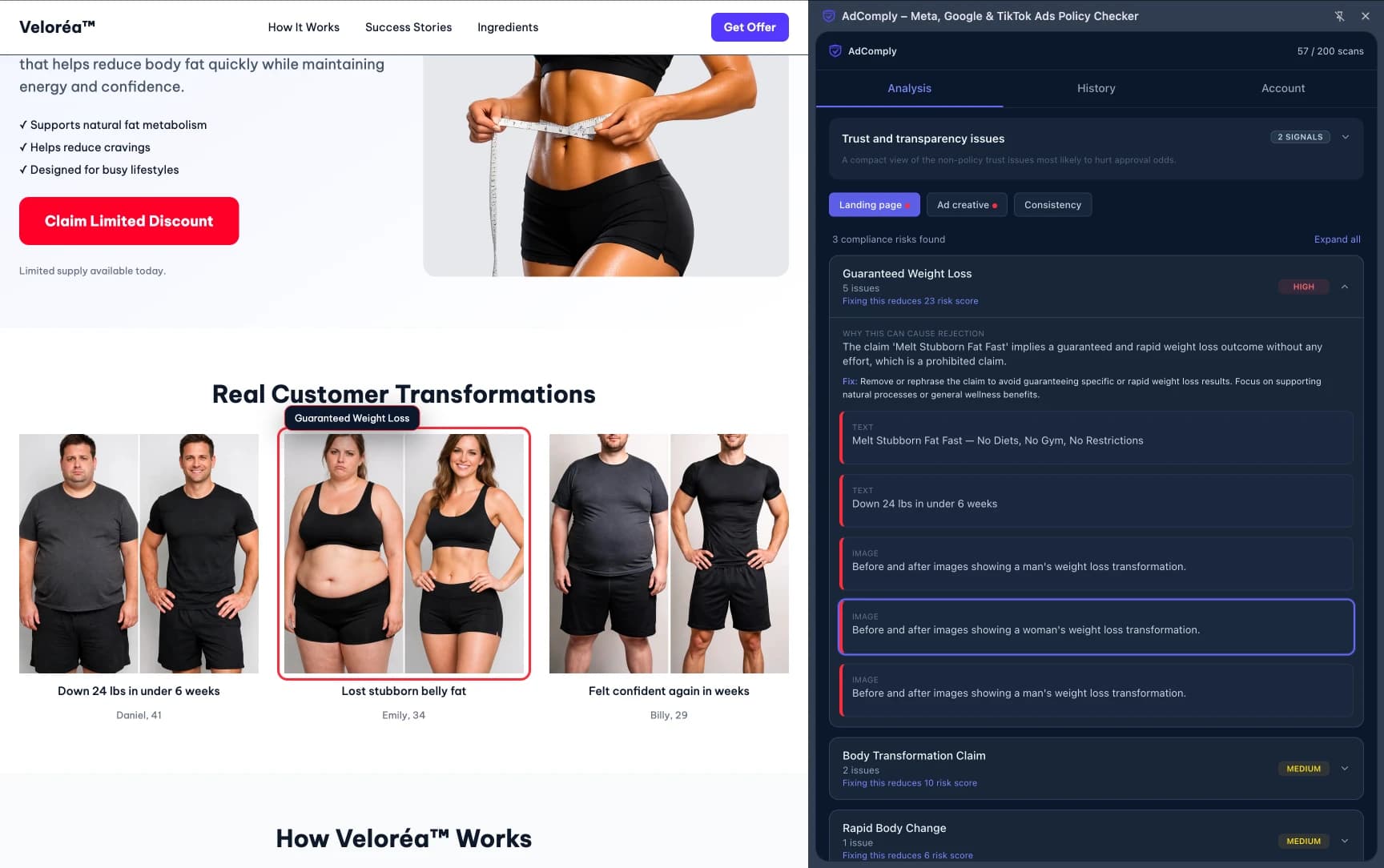
That’s often enough to shift how the system interprets the promise.
Because it evaluates the combined signal, not just the text.
Timing Changes the Meaning of a Promise
Another layer that often gets overlooked is timing.
When information appears affects how the promise is interpreted.
I’ve seen ads that clearly explain the offer, but landing pages delay key details behind interaction.
From a funnel perspective, that’s normal.
From a system perspective, it looks like the user is being pushed forward before understanding the full promise.
That creates ambiguity.
And ambiguity increases risk.

I’ve tested this directly — bringing clarity earlier reduced rejection frequency without changing the message.
Same promise. Different timing.
Different outcome.
Why “Technically Accurate” Isn’t Enough
This is where most advertisers get stuck.
Find Rejection Risks Before You Submit
Scan your ad funnel for policy risks, risky claims, landing-page issues, and ad-to-page mismatches before review.
No signup required • instant results • 5 free scans included
The promise is accurate.
The wording is correct.
Nothing is misleading.
And still — the ad gets rejected.
I’ve had moments where I was sure everything was compliant, until I stepped through the funnel as a user.
That’s when the issue became obvious.
Not in the content.
In the shift between steps.
Because the system doesn’t validate truth.
It validates consistency.
This is closely related to patterns that trigger circumventing systems flags, where inconsistency across the funnel creates perceived intent issues.
How to Keep Promises Aligned
Fixing this isn’t about making the promise weaker.
It’s about making it consistent.
I’ve found that the simplest way to approach this is to ask:
Does the landing page confirm the exact expectation set by the ad?
If the answer is even slightly “not really”, that’s where the issue is.
Sometimes the fix is rewriting.
Sometimes it’s removing elements.
Sometimes it’s just changing timing.
But the goal is always the same:
remove interpretation.
The Shift That Makes This Predictable
At some point, the question changes.
Not “is this promise allowed?”
But “does this promise stay stable from start to finish?”
That shift is what makes ad behavior predictable.
You stop focusing on individual claims.
You start focusing on continuity.
If you want to see how promise alignment affects real funnels, explore ad risk examples with breakdowns of consistency patterns.
Because rejections don’t come from promises alone.
They come from how those promises change across the funnel.
And once that change becomes visible, the outcome is rarely surprising.