


A page can look completely fine and still get you flagged.
That’s usually the moment when people start questioning everything. Not just the copy, but the whole setup.
I’ve had landing pages where nothing stood out as risky. No exaggerated claims, no shady UI tricks, no obvious violations. If anything, they looked cleaner than most competitors.
And still — rejections kept coming back.
After a while, you stop looking for “what’s wrong” and start asking a different question:
what does this page look like to the system?

Because that’s the part most people underestimate — compliance isn’t judged like a human review. It’s inferred from patterns.
And a landing page becomes “non-compliant” not when it clearly breaks a rule, but when it starts resembling structures that historically led to bad outcomes.
Non-compliance is often structural, not explicit
The default assumption is that something has to be clearly misleading for a page to be non-compliant.
In practice, that’s rarely the case.
Most of the pages I’ve seen get flagged were in a gray zone:
technically accurate
visually clean
no obvious red flags
But when you zoom out, the structure starts to look familiar.
I’ve had funnels where removing a single section — not rewriting, just removing — changed how consistently ads got approved.
That’s when it becomes obvious: the system isn’t reacting to individual elements. It’s reacting to the pattern they create together.
Delayed clarity turns a “normal” page into a risky one
One of the most common things I see is pages that don’t immediately explain what the user is getting.
Instead, they start with:
“Check if you qualify”
“See if you’re eligible”
“Start your verification”
And only later — after interaction — the actual offer becomes clear.
From a funnel perspective, that’s normal.
From a compliance perspective, it can look like information is being intentionally withheld.
I’ve tested this directly: same page, same offer, same copy — just moving the explanation above the fold reduced rejection frequency.
No wording changes. Just timing.
That’s the pattern: if the system sees action before clarity, it raises risk.
Mismatch between ad and landing page creates ambiguity
This one is subtle, but it’s everywhere.
You’re not lying. You’re just not saying the same thing in the same way.
And that’s enough.
Typical examples:
Ad emphasizes results, landing page emphasizes process
Ad uses strong wording, page softens it with disclaimers
Same offer, slightly different framing
Each piece is defensible on its own.
Together, they create inconsistency.
And inconsistency is one of the strongest signals the system reacts to.
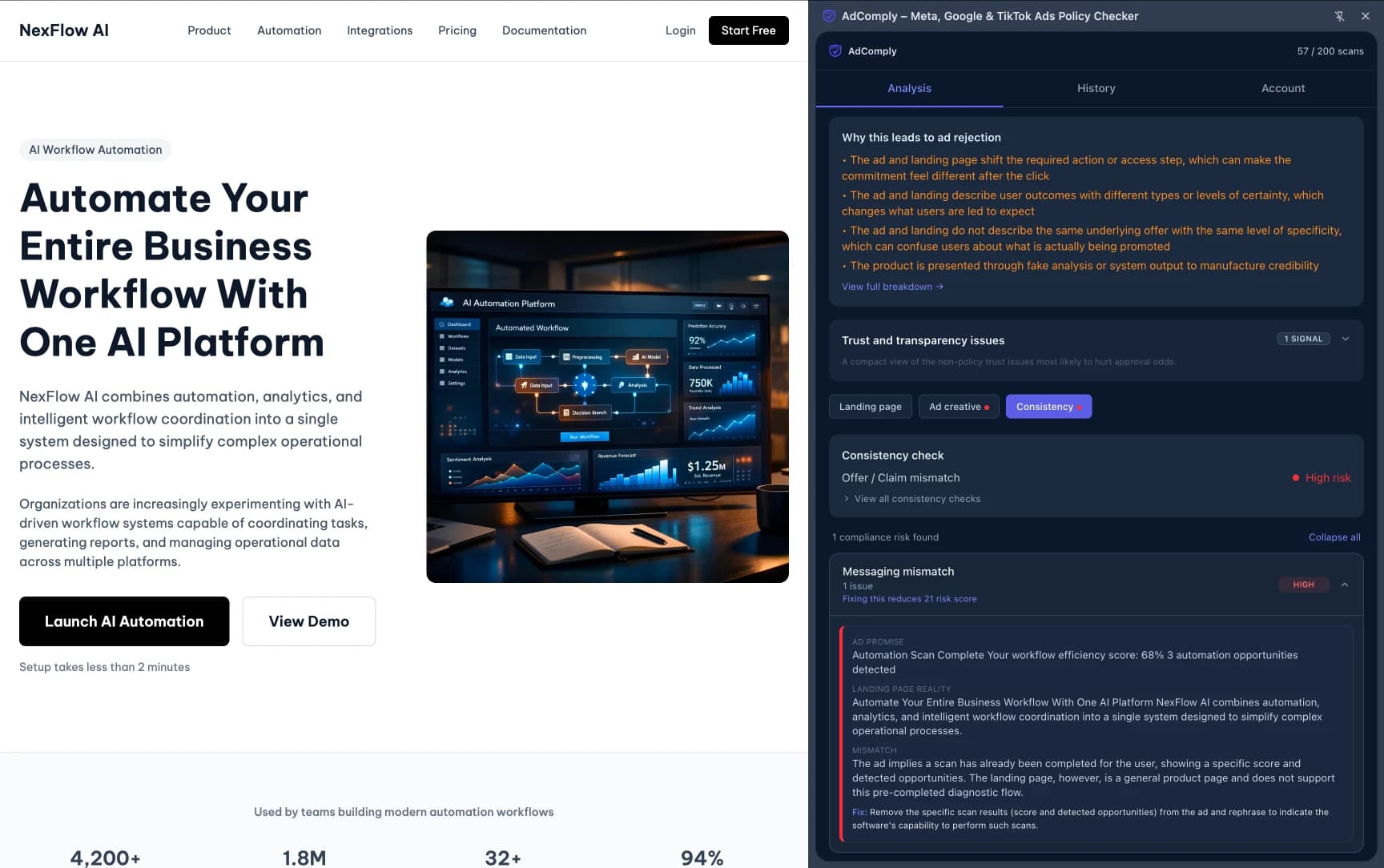
This is one of the most common real-world rejection patterns — broken down in Landing Page Elements That Trigger Ad Rejections, where small differences between ad and page lead to flags.
I’ve had campaigns where aligning just one sentence between ad and landing page resolved repeated rejections.
Same meaning. Same words.
That level of alignment removes interpretation gaps.
Qualification funnels inherit risk by default
There’s a category of funnels that tends to get flagged even when they’re legitimate.
They usually follow this structure:
promise of access or opportunity
eligibility step
multi-step form
full explanation later
I’ve seen this exact setup trigger flags across different niches — not because of the offer itself, but because of the structure.
The system has seen this pattern too many times in misleading contexts.
So when your page resembles it, you inherit that risk.
Even if everything is legitimate.
The simplest mitigation I’ve seen work consistently:
Explain the offer clearly before any qualification step.
Not partially. Not vaguely.
Clearly.
Claims without immediate context look unsupported
You don’t need extreme claims to run into issues.
Even generic statements can become problematic if they appear without context.
Things like:
“Improve your results”
“Increase performance”
“Boost conversions”
These are everywhere.
And they’re fine — as long as they’re immediately explained.
I’ve seen pages where the explanation existed, but too far down.
From a human perspective, it’s there.
From a structural perspective, it’s delayed.
And that delay changes how the system interprets the claim.
If a claim appears before its context, it can be treated as unsupported — even if the explanation exists later.
Visual patterns can trigger non-compliance
One of the more surprising things: sometimes the issue isn’t text at all.
I’ve had ads go from rejected to approved just by removing an image.
No other changes.
The system’s computer vision doesn’t just detect objects — it interprets patterns.
And certain visuals carry built-in risk:
dashboards showing growth
simulated “results” screens
before/after transformations
Even if your copy is clean, these visuals can imply outcomes or simulate functionality.
That’s often enough to trigger a flag.
It’s not about what you meant. It’s about what the pattern suggests.
Disclaimers don’t neutralize strong messaging
A common assumption is that disclaimers make everything safe.
In practice, they can introduce another problem.
Mismatch.
For example:
Main message: strong, outcome-focused
Disclaimer: soft, limiting, conditional
Both are acceptable individually.
Together, they create tension.
The system sees a strong promise followed by a soft contradiction.
And that inconsistency increases risk.
I’ve seen pages where simply moving the disclaimer closer to the claim improved approval stability.
No wording changes. Just alignment.
Lack of trust signals shifts classification
This is one of those factors that rarely gets discussed.
Not because it’s unimportant, but because it doesn’t show up as a clear violation.
Pages without basic trust elements tend to get flagged more often when combined with other signals.
Things like:
missing privacy policy
no contact information
inconsistent branding
unfinished sections
Individually, they might not matter.
But they change how the page is categorized.
I’ve had cases where adding basic legal and contact elements reduced rejection frequency without touching the core funnel.
Not because of a rule — but because the page started looking more legitimate overall.
Over-optimized funnels can cross the line
This is where performance marketing and compliance start to clash.
The same tactics that improve conversions can increase perceived risk.
Examples:
multiple urgency triggers
constant scarcity messaging
aggressive CTA repetition
I’ve had funnels where removing just one urgency element made approvals more stable, without hurting performance.
Find Rejection Risks Before You Submit
Scan your ad funnel for policy risks, risky claims, landing-page issues, and ad-to-page mismatches before review.
No signup required • instant results • 5 free scans included
There’s a tipping point.
And pushing past it makes the page look less like a normal experience and more like a high-pressure flow.
Why pages become non-compliant over time
One of the more confusing scenarios is when a page works — and then suddenly doesn’t.
No changes. Same setup.
It feels random.
But it usually isn’t.
The system accumulates signals over time.
Patterns become clearer.
And once enough signals align, the classification shifts.
That’s when the page starts getting flagged.
This threshold effect is also why some ads get rejected instantly after running fine before — covered in Facebook Ads Rejected Instantly: What Causes It.
Understanding this helps reframe the issue.
You’re not dealing with randomness.
You’re dealing with delayed pattern recognition.
What actually makes a page “non-compliant”
It’s not a single violation.
It’s a combination of signals:
delayed clarity
messaging inconsistency
high-risk funnel structure
unsupported claims (structurally)
visual patterns that imply outcomes
low trust baseline
Each one adds weight.
At some point, the page crosses a threshold.
And that’s when it’s treated as non-compliant.
The shift that changes everything
At some point, you stop asking:
“Is this allowed?”
And start asking:
“What pattern does this create?”
That shift is what makes landing page issues predictable.
Not perfectly — but enough to avoid most of the situations that lead to repeated rejections.
And once you start thinking in patterns instead of rules, “non-compliance” stops being a vague label.
It becomes something you can actually see before it becomes a problem.