


Inconsistency between ads and landing pages almost never looks dramatic.
There’s no obvious contradiction. No clear violation. Nothing that immediately looks like an error.
That’s why it’s easy to miss.
I’ve had funnels where both the ad and the landing page looked completely fine on their own. Clean, compliant, nothing risky.
But when you actually moved through the flow, something changed.
Not enough to call it wrong.
Just enough to feel different.
That’s where inconsistency usually lives.
And that’s exactly what platforms detect.
Inconsistency Is About Shifts, Not Contradictions
Most people expect inconsistency to be obvious.
The ad says one thing. The landing page says something else.
In practice, it’s rarely that clean.
It’s usually a shift in interpretation.
I’ve seen funnels where everything was technically aligned — but the tone, timing, or emphasis changed just enough to alter meaning.
That’s all it takes.
Example 1: Exploration vs Immediate Action
This is one of the most common patterns.
Ad: “Discover how teams are improving their workflows” (exploratory, low pressure)
Landing page: “Start optimizing your workflow today” (direct, action-driven)
Inconsistency: exploration → commitment
Nothing misleading.
But the expectation changes.
I’ve seen this exact shift reduce approval stability without any changes to the offer itself.
Because the system reads that as a change in intent.
Example 2: Clear Ad → Hidden Offer on Landing Page
This one is more structural.
Ad: clearly explains what the user will get
Landing page: asks for input before explaining the offer
Inconsistency: upfront clarity → delayed clarity

From a funnel perspective, this is normal.
But it becomes a consistency issue when the ad already sets a clear expectation — and the landing page withholds that same clarity.
I’ve tested this directly: moving the explanation above the fold reduced rejection frequency without changing any wording.
Same offer. Same copy.
Different timing.
Different interpretation.
Example 3: Neutral Ad vs Implied Results on Landing Page
Sometimes the inconsistency comes from visuals, not text.
Ad: neutral messaging, no strong outcome implied
Landing page: before-and-after visuals or transformation cues
Inconsistency: neutral → implied results
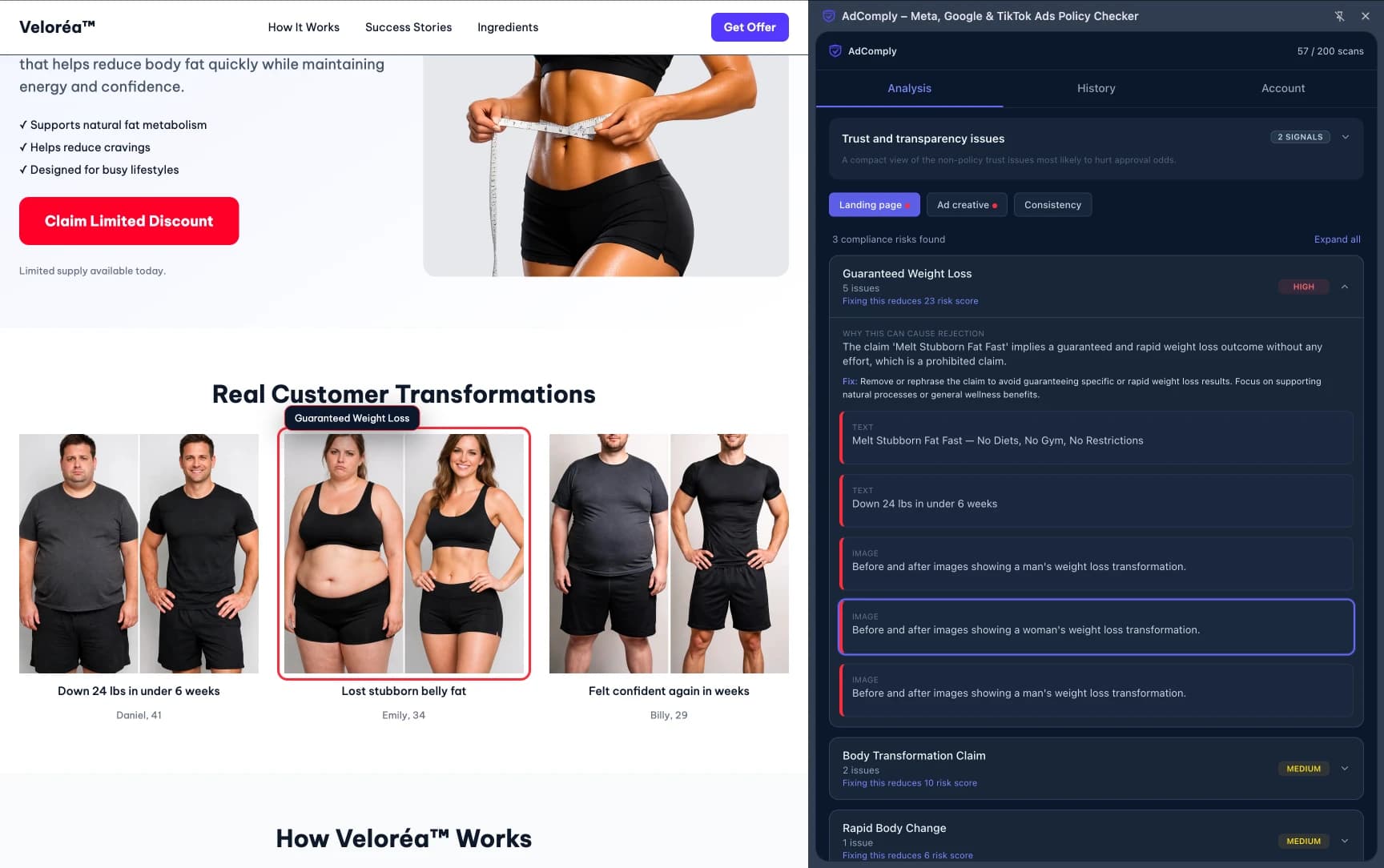
On its own, this type of visual might not be a violation.
But it becomes a consistency issue when the ad does not establish the same level of expectation.
I’ve had campaigns where removing just the visual stabilized approvals.
No copy changes.
Just alignment.
Example 4: Simple Entry vs Conditional Reality
This one shows up a lot in finance, SaaS, and employment funnels.
Ad: low-friction entry point
Landing page: introduces conditions, steps, or requirements
Inconsistency: simplicity → qualification
The content is accurate.
But the expectation changes.
I’ve seen this cause issues even when both sides are technically compliant.
Because the user experience doesn’t match what was initially implied.
Example 5: Gradual Escalation Across the Funnel
This is where inconsistency becomes harder to detect.
No single step looks problematic.
But the pattern builds:
ad introduces softly
landing page strengthens the message
next step adds urgency
Each change is small.
Together, they create escalation.
I’ve seen funnels like this run fine initially — then start getting flagged later.
Not because anything changed.
Because the pattern became visible.
Why These Inconsistencies Are Easy to Miss
The frustrating part is that everything looks fine in isolation.
You review the ad — no issue.
You review the page — also no issue.
But the system doesn’t evaluate isolation.
It evaluates continuity.
I’ve had moments where I couldn’t see the issue until I stepped through the funnel as a user.
That’s usually when the shift becomes obvious.
Not in what was said.
In how it changed.
This is closely related to circumventing systems patterns, where small shifts across the funnel change how intent is classified.
Inconsistency Is a Pattern, Not a Bug
You’re not looking for a broken element.
You’re looking for a pattern.
I’ve seen the same inconsistency structures appear across completely different industries.
Check Your Landing Page Before Running Ads
Analyze your landing page for risky claims, missing disclosures, trust gaps, and funnel issues before launching traffic.
No signup required • instant results • 5 free scans included
Not because the content was the same.
Because the flow was.
Once you start recognizing those flows, inconsistencies stop feeling random.
The Shift That Changes How You Diagnose Funnels
At some point, the question changes.
Not “what’s wrong with this page?”
But “where does the experience change?”
That shift is what makes these issues easier to fix.
You stop analyzing elements.
You start analyzing transitions.
If you want to see more real breakdowns, explore ad risk examples where these patterns are analyzed step by step.
Because inconsistency doesn’t come from obvious mistakes.
It comes from small shifts.
And once those shifts stack, the outcome becomes predictable.