


Most people approach Google Ads landing page requirements like a checklist.
Add a privacy policy. Make sure the page loads. Don’t hide the offer. Avoid misleading claims.
On paper, it feels straightforward.
But then something strange happens.
You follow all the visible rules — and the ads still get disapproved, limited, or just never scale properly.
I’ve had landing pages that were technically perfect. Fast load times, clear copy, full compliance elements, nothing hidden.
And still — performance stalled or approvals became inconsistent.
That’s usually where the misunderstanding becomes obvious.
Google doesn’t evaluate landing pages as a checklist. It evaluates them as a system of signals.
And once you start looking at it that way, the requirements stop feeling arbitrary. They start making sense.
What Google Ads Actually Evaluates on Landing Pages
The official requirements talk about things like transparency, relevance, and usability.
But those are categories, not mechanisms.
In practice, Google is trying to answer a much simpler question:
Is this page predictable, trustworthy, and aligned with the ad?
Everything else flows from that.
I’ve seen pages that technically “met requirements” but still failed this test. Not because of one issue — but because the overall experience felt inconsistent.
Google doesn’t check elements. It evaluates how those elements work together.
How Google Evaluates Landing Page Experience
Landing page experience is often treated like a score, but it’s really a pattern.
The system looks at page speed, content clarity, navigation, and alignment with the ad. Individually, none of these are complicated.
Together, they define how predictable the page feels.
I’ve had pages where improving load speed didn’t change anything — but simplifying the layout immediately improved performance. Same content, different structure.
This is also where Google behaves differently from most platforms — because these signals don’t just affect approval. They directly impact cost.
I’ve seen pages with weaker structure pass review but still perform worse simply because the landing page experience score was lower. Same ad, same targeting — higher CPC.
That’s the part many people miss: a “technically compliant” page can still make your traffic more expensive.
Because Google doesn’t just decide whether your ad runs.
It decides how much you pay to run it.
Relevance Is About Continuity, Not Keywords
One of the most misunderstood requirements is relevance.
Most people reduce it to keyword matching — same words in the ad and on the page.
But Google evaluates continuity.
Does the landing page feel like a natural continuation of the ad, or does it shift tone, intent, or expectation?
I’ve seen ads that were informational, leading to pages that immediately pushed conversion. Nothing misleading — just a shift.
That alone can reduce trust signals.
And when trust drops, performance follows.
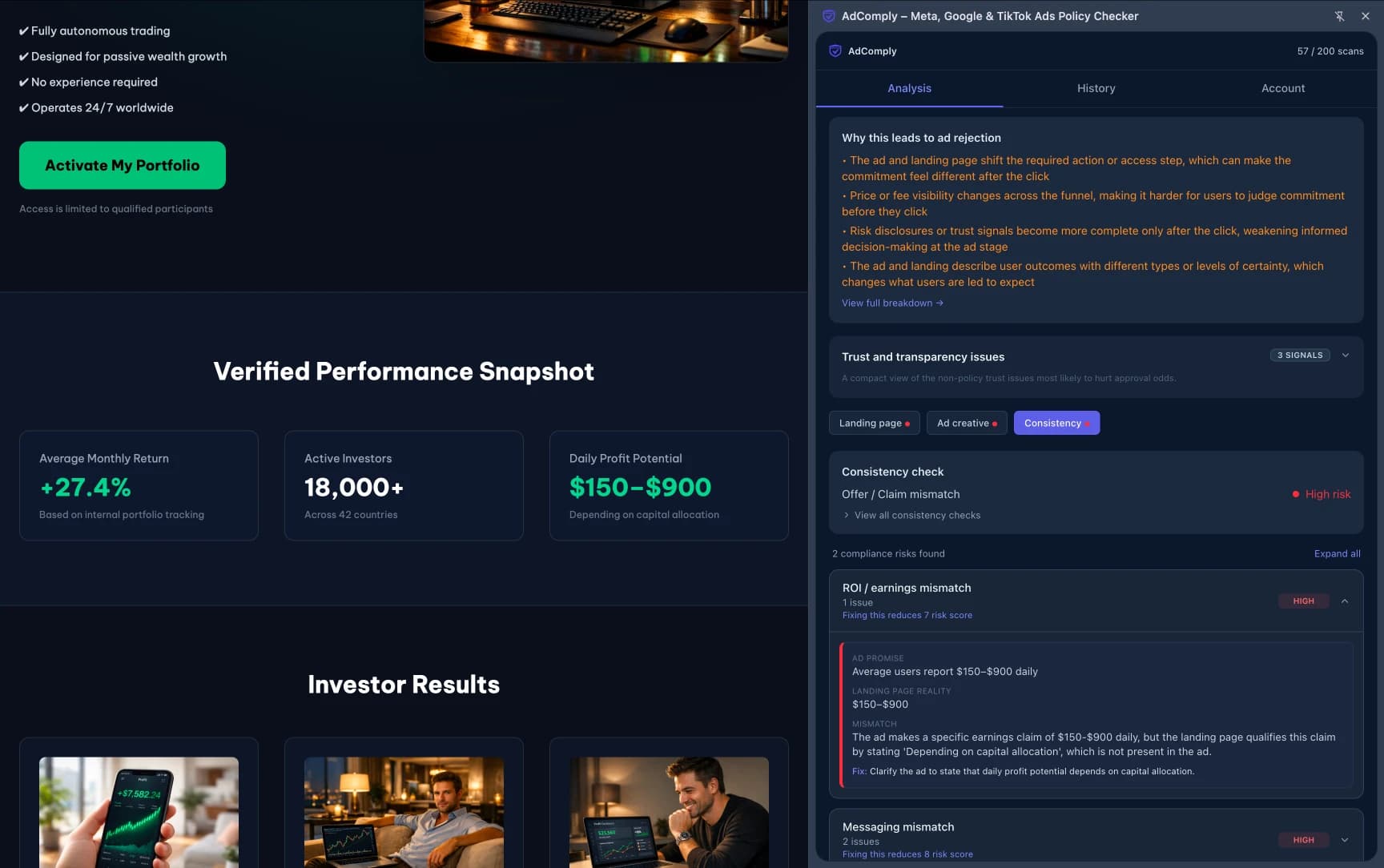
This type of inconsistency shows up across platforms — especially in landing page element breakdowns where small differences between ad and page create risk.
I’ve had campaigns where aligning just the headline between ad and page improved both approval stability and conversion rates. Same offer, same traffic — just cleaner continuity.
Transparency Is Structural, Not Just Legal
Google emphasizes transparency, but this goes beyond having legal pages in your footer.
It’s about how clearly the offer is explained — and when.
I’ve seen funnels where all the required information was technically present, but delayed. Pricing, conditions, or limitations appeared only after interaction.
From a user perspective, it’s still there.
From a system perspective, it looks like friction before clarity.
Find Rejection Risks Before You Submit
Scan your ad funnel for policy risks, risky claims, landing-page issues, and ad-to-page mismatches before review.
No signup required • instant results • 5 free scans included
And that changes classification.
In practice, the safest structure is simple: explain first, then ask for action.
Google Detects Intent Through Page Structure
Intent is not something you declare. It’s something the system infers.
What appears first, what gets repeated, what gets emphasized — all of that builds a signal.
I’ve had pages where removing a single section changed approval stability. Not because the section was wrong, but because it shifted the overall pattern.
This is where most people get stuck. They try to fix lines, but the system reacts to structure.
Misleading Content Is Often Unintentional
When people hear “misleading,” they think of obvious exaggeration.
But in practice, most issues are subtle.
I’ve seen pages flagged not because they lied — but because they implied too much.
This usually comes from stacked testimonials, visual “results,” or progression narratives.
Before you launch: A quick scan can show the issues that often lead to ad rejection before you send the campaign for review.
Scan your funnel now →Individually, they’re fine.
Together, they create expectations that aren’t clearly supported.
And that’s where classification shifts.
Technical Compliance Is Necessary — But Not Enough
Page speed, mobile optimization, and functional links are all required.
But they don’t guarantee approval or performance.
I’ve had technically flawless pages that still struggled to scale.
Because technical compliance solves only one layer.
The deeper layer is interpretive.
Does the page feel consistent, clear, and trustworthy?
User Signals Feed Back Into Evaluation
Google pays close attention to how users interact with your page.
Bounce rate, engagement, time on page — these signals don’t just affect analytics. They affect delivery.
I’ve seen campaigns where nothing changed in the funnel, but performance dropped over time.
The issue wasn’t policy.
It was behavior.
If users don’t trust or understand the page, the system picks up on that.
Why Landing Pages Stop Working Over Time
A page can work perfectly — and then suddenly stop scaling.
No changes. Same setup.
It feels random, but it usually isn’t.
The system accumulates signals over time. Patterns become clearer.
Once enough signals align, the classification shifts.
And performance drops.
What Google Ads Landing Page Requirements Really Enforce
They don’t enforce a checklist.
They enforce alignment.
Between ad and page, promise and explanation, structure and intent.
Each element adds weight.
At some point, the page crosses a threshold.
And that’s when outcomes change.
How to Understand Google Ads Landing Page Requirements in Practice
At some point, the question changes.
Not “does this meet the requirements?”
But “what pattern does this create?”
That shift is what makes Google Ads predictable.
You stop fixing pieces and start evaluating systems — structure, clarity, consistency, behavior.
If you want to see how these patterns appear in real funnels, explore ad risk examples with detailed breakdowns.
Because Google doesn’t evaluate pages in isolation.
It evaluates alignment.
And once that alignment becomes clear, the outcome is no longer surprising.