


Most ad violations don’t look like violations when you first see them.
The ad feels clean. The landing page looks polished. Nothing obviously misleading, nothing aggressive enough to raise suspicion.
And yet — the ad gets rejected.
Or it runs for a bit, then suddenly drops, or starts getting flagged inconsistently.
I’ve had funnels where every individual piece looked fine in isolation. You review the ad — no issue. You review the page — also fine.
But the moment you move through the flow, something shifts.
Not enough to call it “wrong”. Just enough to feel off.
That’s usually where the violation actually lives.
Because platforms don’t evaluate parts.
They evaluate patterns.
Most Violations Come From Mismatch, Not Rules
There’s a common assumption that violations happen when you break a rule.
Make a claim too strong. Say something not allowed. Hide something critical.
That does happen.
But in practice, a large share of rejections come from something less obvious.
Mismatch.
The ad sets one expectation.
The landing page slightly reframes it.
I’ve seen ads that were perfectly compliant get rejected simply because the page shifted tone just enough to change interpretation.
Nothing false.
Just inconsistent.
Example 1: Hidden Offer Behind Interaction
This one shows up constantly in lead generation funnels.
Ad: clearly describes the offer
Landing page: asks for input before explaining details
Violation pattern: clarity → gated explanation
From a funnel perspective, this is normal.
From a system perspective, it can look like the user is being pushed into action before understanding what they’re getting.

I’ve tested this directly — same funnel, same copy, just moving the explanation higher reduced rejection frequency.
No wording changes. Just timing.
That’s the pattern: when clarity is delayed, intent becomes harder to classify.
Example 2: Neutral Framing vs Outcome Reinforcement
This one is more subtle.
Ad: “Explore how this system works” (neutral, informational)
Landing page: “Start seeing results immediately” (outcome-focused)
Violation pattern: exploration → implied results
Each part is defensible.
Together, they create a stronger promise than originally stated.
I’ve had campaigns where softening just the landing page headline fixed repeated rejections.
Same offer. Same structure.
Different alignment.
Example 3: Visual Mismatch Without Changing Copy
Sometimes the issue isn’t text at all.
I’ve had ads go from rejected to approved just by removing visuals.
No copy changes.
The reason is simple: visuals imply outcomes.
Ad: clean, neutral visuals
Landing page: before/after imagery or strong transformation signals
Violation pattern: neutral → implied dramatic result
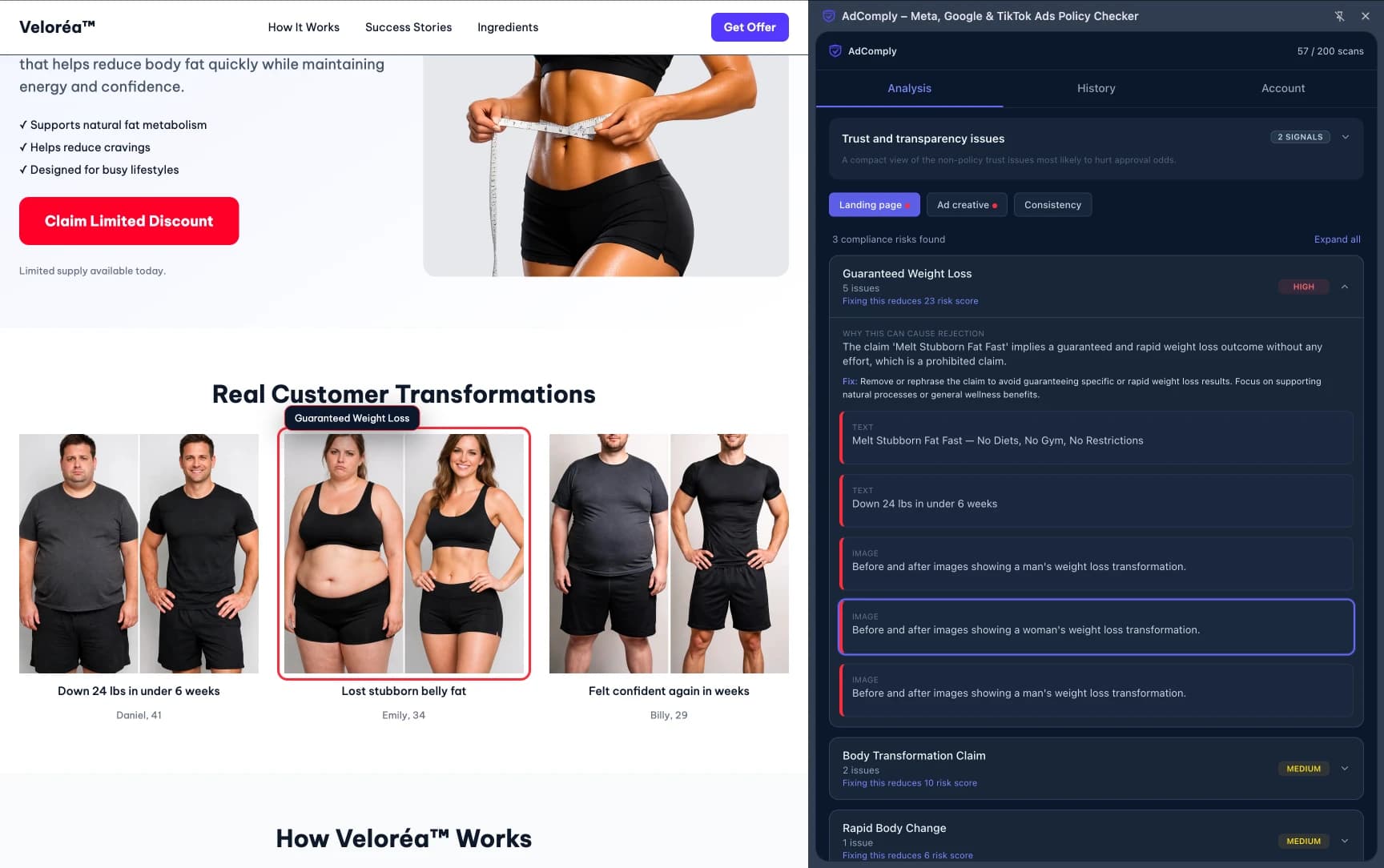
Even if the copy stays safe, the visual layer changes how the system interprets the offer.
And that’s often enough to trigger a flag.
Example 4: Simplified Entry vs Real Complexity
Another common pattern goes in the opposite direction.
Ad: simple entry point, low friction
Landing page: multiple conditions, steps, limitations
Violation pattern: simplicity → conditional reality
This creates a different kind of mismatch.
The ad reduces friction.
The page reintroduces it.
I’ve seen this especially in finance and employment funnels.
The system reads that as a gap between expectation and actual experience.
Example 5: Gradual Escalation Across the Funnel
This is where things become harder to spot.
No single step is problematic.
But the pattern builds:
ad slightly simplifies
page slightly strengthens the promise
next step introduces urgency
Each change is small.
Together, they create escalation.
I’ve seen funnels like this run fine at first — then get flagged later.
Not because something changed.
Because the pattern became clear.
Why These Violations Are Hard to Catch
The frustrating part is that everything looks fine when you check it piece by piece.
You’re not doing anything obviously wrong.
But the system isn’t checking pieces.
It’s evaluating continuity.
I’ve had cases where I couldn’t see the issue until I walked through the funnel like a user.
That’s usually where the shift becomes obvious.
Not in the content.
In the transition.
If you want to break this down deeper, see why Meta flags ads for circumventing systems, where these patterns often escalate into violations.
Violations Are Pattern Recognition, Not Rule Enforcement
This is the shift that makes everything clearer.
Find Rejection Risks Before You Submit
Scan your ad funnel for policy risks, risky claims, landing-page issues, and ad-to-page mismatches before review.
No signup required • instant results • 5 free scans included
You’re not dealing with a list of forbidden elements.
You’re dealing with recognizable structures.
I’ve seen the same patterns trigger flags across completely different niches.
Not because the content was identical.
Because the structure was.
Once you start seeing those structures, violations stop feeling random.
The Shift That Makes This Predictable
At some point, the question changes.
Not “is this allowed?”
But “does this stay consistent from start to finish?”
That shift is what makes these issues manageable.
You stop checking elements.
You start checking alignment.
If you want to see these patterns in real scenarios, explore ad risk examples with breakdowns of how funnels get flagged.
Because most violations don’t come from obvious mistakes.
They come from small inconsistencies.
And once those inconsistencies stack, the outcome becomes predictable.